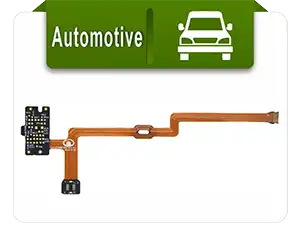
Automotive Flexible Circuit Boards
Automotive flexible circuit boards are thin, bendable interconnects used in vehicles to reliably route signals and power in tight, high-vibration environments. They integrate polyimide substrates and rolled copper traces to withstand temperature extremes from -40°C to +150°C, enabling lightweight, space-saving electronic packaging across ECUs, sensors, lighting, and battery systems.
Flexible Circuit Boards in Automotive Electronics
With the rapid evolution of automotive intelligence, traditional rigid PCBs are increasingly inadequate. Cars have limited space.
There is a need to reduce weight. High vibration resistance is also important. These factors are causing flexible circuit boards (FPC/flex circuits) to grow quickly in automotive electronics.
Light, compact, and durable flexible PCB solutions offer design freedom that traditional PCBs cannot provide. This opens up new possibilities for modern vehicle systems.
Many vehicles today contain flexible printed circuit boards. Infotainment systems and rigid-flex boards with complex shapes use them. As cars become more electric and self-driving, it is important to partner with licensed FPC manufacturers for success.
Scroll down to learn more application details!
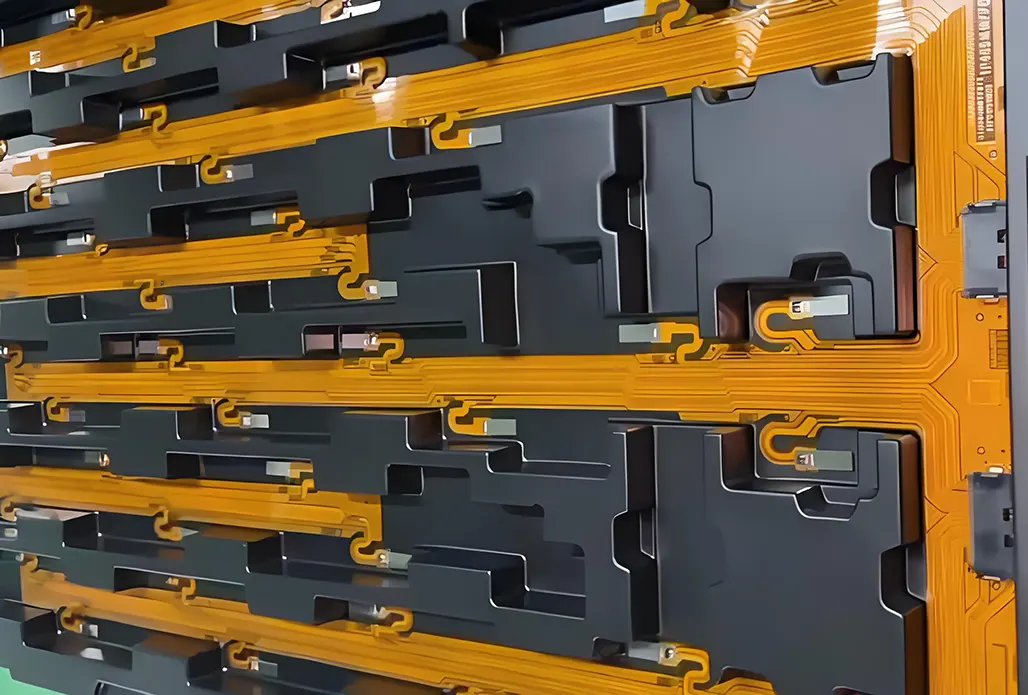
Automotive Flexible Circuit Board Applications
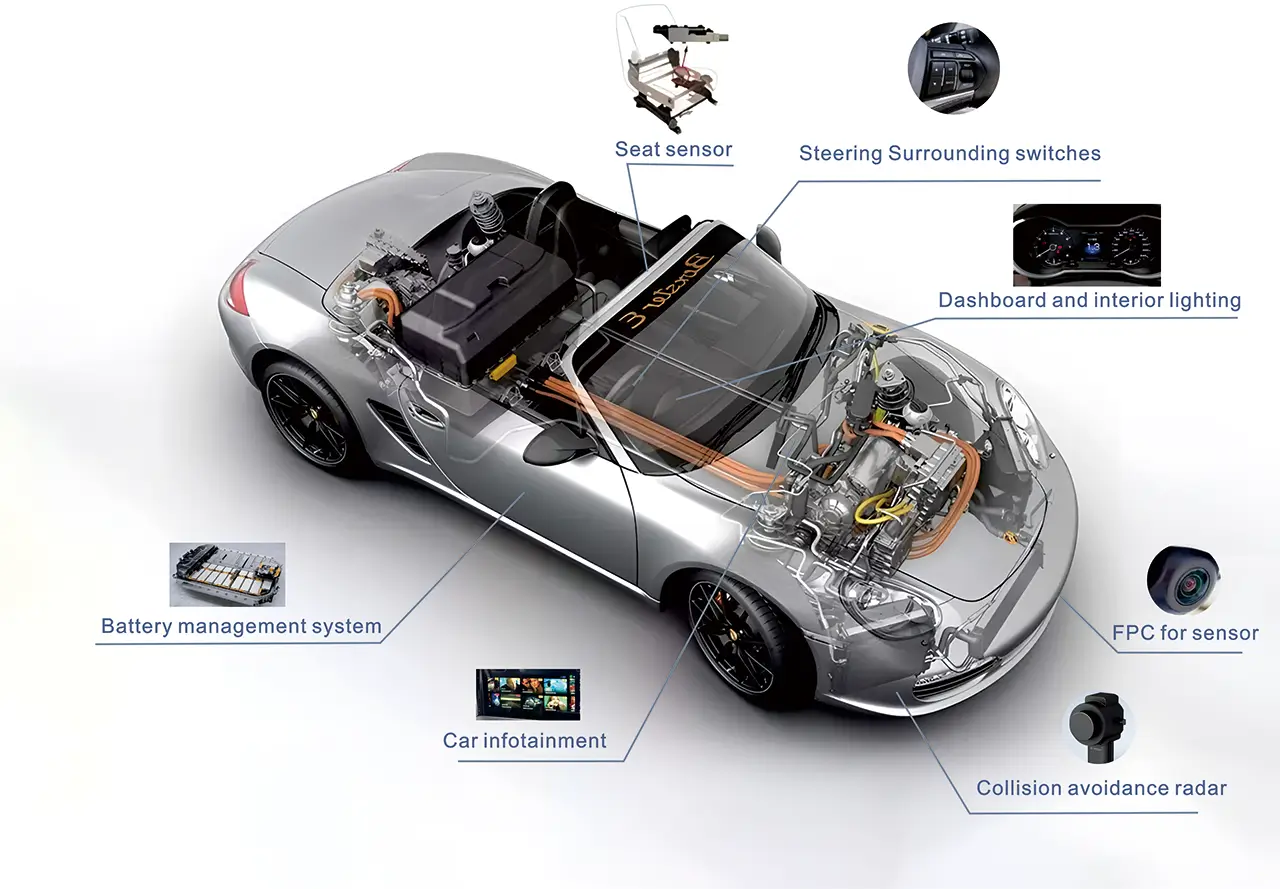
- ECUs & Domain Controllers: Compact flex layers reduce harness weight and simplify high-density routing.
- Sensors (LiDAR, Radar, Camera): Flexible tails enable 3D positioning and vibration absorption.
- LED Lighting: Bendable circuits conform to lamp housings and support matrix LED control.
- Battery Management Systems: Flex interconnects handle cell monitoring and high-temperature operation.
- Infotainment & Displays: Flex-to-board connections allow slim dashboards and folding screens.
- ADAS & Autonomous Driving: Reliable flex circuits connect cameras, radar, and compute modules with high signal integrity.
Flexible PCB in Automotive Lighting
Flexible PCBs enable sleek, curved LED light bars and full-width tail lamps by conforming to complex 3D shapes. Polyimide substrates provide thermal stability for high-brightness LEDs, while Coverlay layers protect circuits from moisture and abrasion. The thin, bendable design improves heat spreading and reduces assembly steps compared to rigid boards.
- LED light strips: Flex circuits bend around corners, enabling continuous illumination without connectors.
- Full-width tail lamps: One continuous flex board replaces multiple rigid PCBs, improving reliability and aesthetics.
- Thermal management: Exposed copper and thin polyimide dissipate heat efficiently, extending LED life.
Flex PCB vs Rigid PCB in Automotive
| Attribute | Flexible PCB | Rigid PCB |
|---|---|---|
| Weight | Lighter – thin polyimide reduces mass by up to 60% | Heavier – FR4 and stiffeners add weight |
| Space Utilization | Bendable 3D routing fits tight enclosures | Planar; requires connectors and cables |
| Reliability | Withstands vibration, shock, and dynamic bending | Prone to solder joint fatigue under vibration |
| Thermal Management | Better heat dissipation via thin substrates and exposed copper | Heat concentrated; may need thermal vias |
| Cost | Higher unit cost but reduces total system cost via integration | Lower unit cost but higher assembly/harness cost |
Automotive Flexible Circuit Boards FAQ
Q: What materials are used in automotive flexible PCBs?
A: Polyimide and polyester with high-temperature/chemical resistance.
Q: How do flex circuits improve reliability?
A: Through thermal management, vibration resistance, and reduced wiring failures.
Q: Are FPCs suitable for EVs?
A: Yes, especially for BMS, electronic control units (ECU), and motor controls.
Q: How does EMI shielding work?
A: Conductive coatings and ground planes protect signals from interference.