
Explore the Cutting – Edge World of PCB Technology!
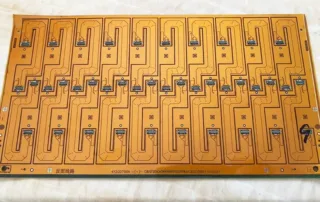
Why Components Fail on Nickel-Gold Plated FPC Boards: Causes and Insights
Before mounting components via SMT, manufacturers must treat the FPC surface and solderable component ends. This ensures solderability, connection reliability, and contact reliability. The surface treatment process significantly impacts SMT placement results and may lead to issues such as soldering defects and assembly failures. Nickel-gold plating serves as an effective surface treatment method. The gold layer prevents oxidation of[...]
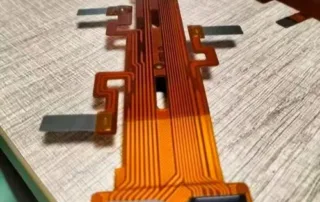
Cutting-Edge 3D Steel Sheet Assembly Technology for Flexible PCB Applications
With the rapid advancement of technology, flexible printed circuit boards (FPCBs) have gained widespread adoption in electronic devices due to their high flexibility, bendability, and lightweight yet durable characteristics. FPCBs play a pivotal role in automotive electronics, smart wearables, smartphones, aerospace, and other fields. However, as product designs grow increasingly complex and performance demands continue to rise, 3D steel[...]
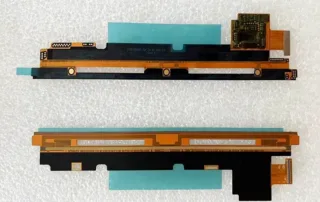
AI-Driven Optimization of Flexible Circuit Boards Production
Flexible circuit boards are optimized through AI-driven FPCB production by combining real-time sensor monitoring with closed-loop adaptive control. The system detects deformation risks, narrow process windows, and environmental interference, then adjusts parameters to support high-precision manufacturing and more stable quality and efficiency. Flexible Circuit Board Production Processes: Key Manufacturing Challenges Flexible circuit boards offer lightweight, bendable, and three-dimensional spatial layout[...]
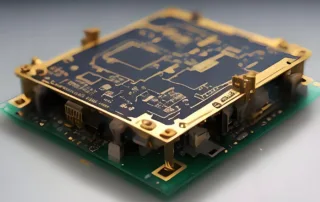
PCB Surface Finish Types Explained: Best Options for Flexible PCBs
Introduction: Why Surface Finish Matters in PCB Fabrication Every circuit board requires protection for its copper traces. Without a reliable finish, exposed copper quickly oxidizes, reducing electrical conductivity and making soldering nearly impossible. This is why PCB surface finishes are a critical step in PCB fabrication. Surface finishes serve as a protective layer. They create a flat surface for attaching[...]
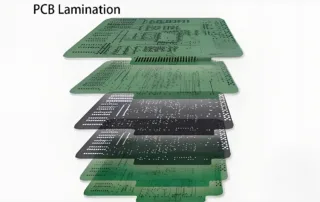
PCB Lamination Process Explained: From Rigid Boards to Flex PCB Manufacturing
PCB Lamination Process Explained: From Rigid Boards to Flex PCB Manufacturing Introduction: Why Lamination Matters in PCB Fabrication Lamination is a key step in making PCBs. It affects how strong and well the finished PCB works. The lamination process is key to making multilayer boards. This includes both rigid boards and flexible circuit boards. It determines how well the[...]
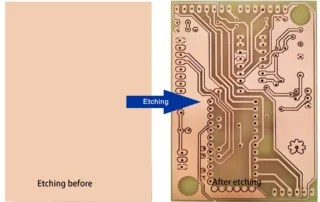
PCB Etching Process: Flexible PCB & Rigid Flex Manufacturing
PCB Etching Process: Flexible PCB & Rigid Flex Manufacturing Introduction The etching task in PCB design is one of the most important steps in making printed circuit boards. It directly influences the precision of the circuit trails, hence performance, as well as the life of the end product. Accurate etching is important. It is used to create a standard[...]