
Flexible PCB Gesture Recognition System for Wearable Human-Machine Int
Flexible PCB Gesture Recognition System for Wearable Human-Machine Int
In many science fiction movies, people can control unmanned devices, send commands, and even communicate silently with machines simply by making a hand gesture.
In the past, this type of interaction often relied on cameras, voice commands, or complex external devices, but these methods are unreliable in dark, noisy, obstructed, or situations where speaking is inconvenient.
Consequently, a more natural approach has emerged: Could machines be made to “understand” human movements directly? For example, what if a thin, flexible sensor circuit attached to the wrist alone could convert gestures, grips, and muscle deformations into electrical signals that machines can interpret?
However, traditional flexible sensor systems often face a major challenge: they consist of numerous sensor units and external wires, the signals are weak and prone to interference, and the devices are not lightweight or comfortable to wear.
Against this backdrop, a group of experts recently published a paper titled “Sensor Circuit Design and Gesture Recognition Application Based on Flexible Printed Circuits,” establishing a complete human-machine interaction chain that spans from the capture of wrist movements and gesture recognition to the remote control of unmanned vehicles.
The paper describes the realization of a complete human-computer interaction chain, ranging from the capture of wrist movements and gesture recognition to the remote control of unmanned vehicles.
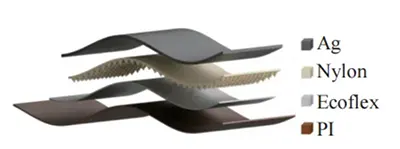
Figure 1. Multilayer structure of the triboelectric sensor
Optimization of Sensor Materials and Structure
The study began by focusing on the material surface. The researchers selected nylon and Ecoflex as the two friction layers and used a method involving hot-pressing with an anodized aluminum template to create a dense micro-nano conical structure on the nylon surface.
This transformed the originally smooth surface into one covered with tiny “spikes,” resulting in a larger effective contact area and higher charge generation efficiency upon contact. Experimental results show that after fabricating the micro- and nano-scale conical structures, the sensor’s peak open-circuit voltage increased from approximately 38 V to about 43 V, representing a 13.1% increase; the peak short-circuit current was approximately 0.42 μA, and the pressure response exhibited good linearity.

Figure 2 Schematic diagram of the process for fabricating conical micro or nano structures on nylon film
Integrated Flexible Circuit Design
In terms of wearability, the study arranged five sensor units around the wrist to form a ring-shaped sensing array.
When a person makes different gestures or grasps different objects, muscles at various locations on the wrist contract and deform in different ways, resulting in distinct combinations of waveforms across the five sensor channels. For example, when gripping an angular block, certain areas experience more concentrated pressure, causing the signal waveforms to be sharper; when gripping a sphere or cylinder, the signal changes are smoother and more balanced.
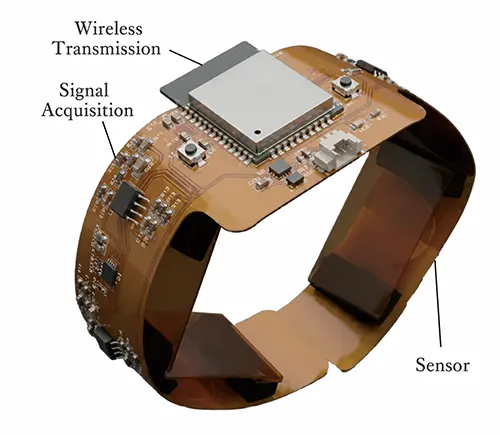
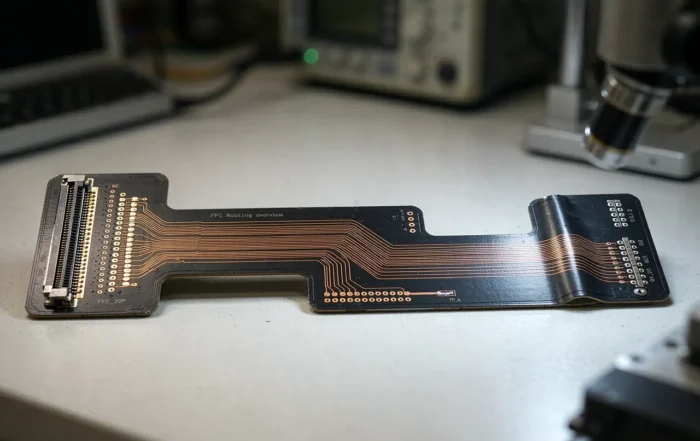
Figure 3 Flexible printed circuit based on a triboelectric sensor array
In terms of circuit design, because triboelectric signals are inherently weak, transmitting them over long wires can easily lead to signal attenuation, noise, and crosstalk.
Therefore, researchers have integrated an amplification circuit, a filtering circuit, two sets of high-precision ADC chips, and an ESP32 wireless module onto a flexible printed circuit board.
The integrated circuitry processes and digitizes the analog signals near the sensor.
It then wirelessly transmits the digital data to a computer, reducing the risk of signal loss and distortion during transmission.
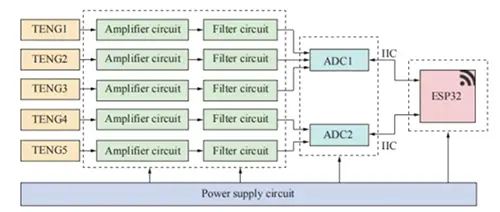
Figure 4 Signal transmission flow chartWEBP
Gesture Recognition Algorithm
To recognize gestures from these complex waveforms, researchers developed a 1D-CNN/MLP neural network model.
In this model, a one-dimensional convolutional neural network (1D-CNN) extracts local waveform features from the five-channel triboelectric time-series data.
A multilayer perceptron (MLP) then maps these high-dimensional features to their corresponding classification categories.
This model outperforms approaches that rely only on handcrafted features such as peak values and mean values.
It also handles continuously changing triboelectric signals more effectively.
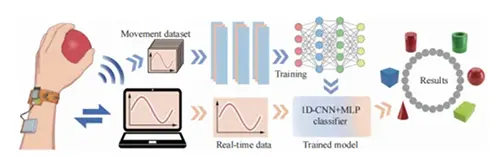
Figure 5 1D CNN or MLP neural network model for object recognition
Testing demonstrated that the system recognized object shapes—including spheres, cubes, cones, rectangular prisms, cylinders, and circular tubes—with 94.2% accuracy.
It also identified gesture commands such as “Hold,” “Cover,” “Comms,” “Right,” “Scout,” and “Advance” with 90.0% accuracy.
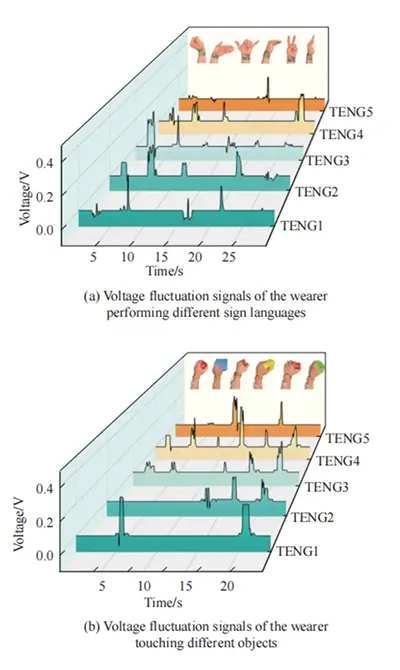
Figure 6. Five channel voltage fluctuation signals captured by the FPC reflecting the wearers movements
Closed-Loop Human-Machine Interaction System
The study further developed a closed-loop human-machine interaction platform. When the wearer performs a specific gesture, the FPC wristband captures five channels of triboelectric signals in real time and wirelessly transmits them to a computer through an ESP32 module.
The host computer runs a neural network model to identify the gesture category, then converts the recognition results into control commands and sends them to a remote unmanned vehicle.
The unmanned vehicle responds to gesture commands by moving forward, turning, and performing other control actions.
It also carries a 5-megapixel CSI camera that streams real-time video back to the host computer interface, allowing operators to monitor the surrounding environment live.
The entire system forms a closed-loop process of “human motion—signal acquisition—intelligent recognition—remote control—visual feedback.”
In open-area testing, the video frame rate was approximately 25 Hz, with end-to-end latency of about 100–300 ms, demonstrating significant potential for real-time interaction.
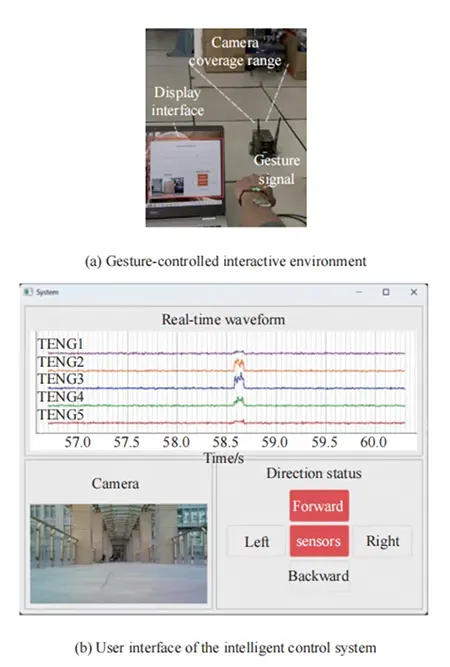
Figure 7 Gesture controlled unmanned vehicle
Limitations and Future Applications
In the future, there is still significant room for improvement in this type of system. For example, the current experiments involved a small number of participants;
Researchers need to validate the system’s stability across a larger group of wearers, different wearing tightness levels, more complex movement patterns, and longer operating periods.
Increasing the sensor array density, optimizing the algorithms, and reducing power consumption could significantly expand the system’s capabilities.
Beyond controlling unmanned devices, the platform could support applications such as rehabilitation training, virtual reality, smart prosthetics, industrial remote operation, and silent communication.
Conclusion
This study demonstrates a flexible, self-powered wrist-worn sensing system that combines triboelectric sensors, flexible printed circuit (FPC) technology, embedded signal-processing circuits, and deep learning to enable reliable gesture recognition and intuitive human-machine interaction.
Researchers significantly increased the sensor’s electrical output by introducing micro- and nano-scale conical structures onto the nylon friction layer.
They also integrated amplification, filtering, ADC, and wireless communication circuits directly onto the flexible printed circuit (FPC), reducing signal degradation and improving overall wearability.
Using a five-channel sensing array and a 1D-CNN/MLP neural network, the system achieved high recognition accuracy for both object shape classification (94.2%) and gesture command recognition (90.0%).
The complete closed-loop platform converts human wrist movements into real-time control commands for an unmanned vehicle.
It delivers low-latency performance with live visual feedback, demonstrating that flexible electronic systems can support practical and intelligent human-computer interaction.
Future research should validate long-term stability across larger user populations.
It should also optimize power consumption and improve system robustness under a wider range of operating conditions.
Despite these remaining challenges, this research establishes a promising framework for developing next-generation wearable interfaces.
The proposed system combines flexible electronics, self-powered sensing, wireless communication, and artificial intelligence into a compact platform.
This integration enables intuitive, hands-free control for applications such as robotics, unmanned systems, virtual reality, rehabilitation, smart prosthetics, industrial teleoperation, and silent human-machine communication.