
FPC Exhaust Gas Treatment Advanced Solutions
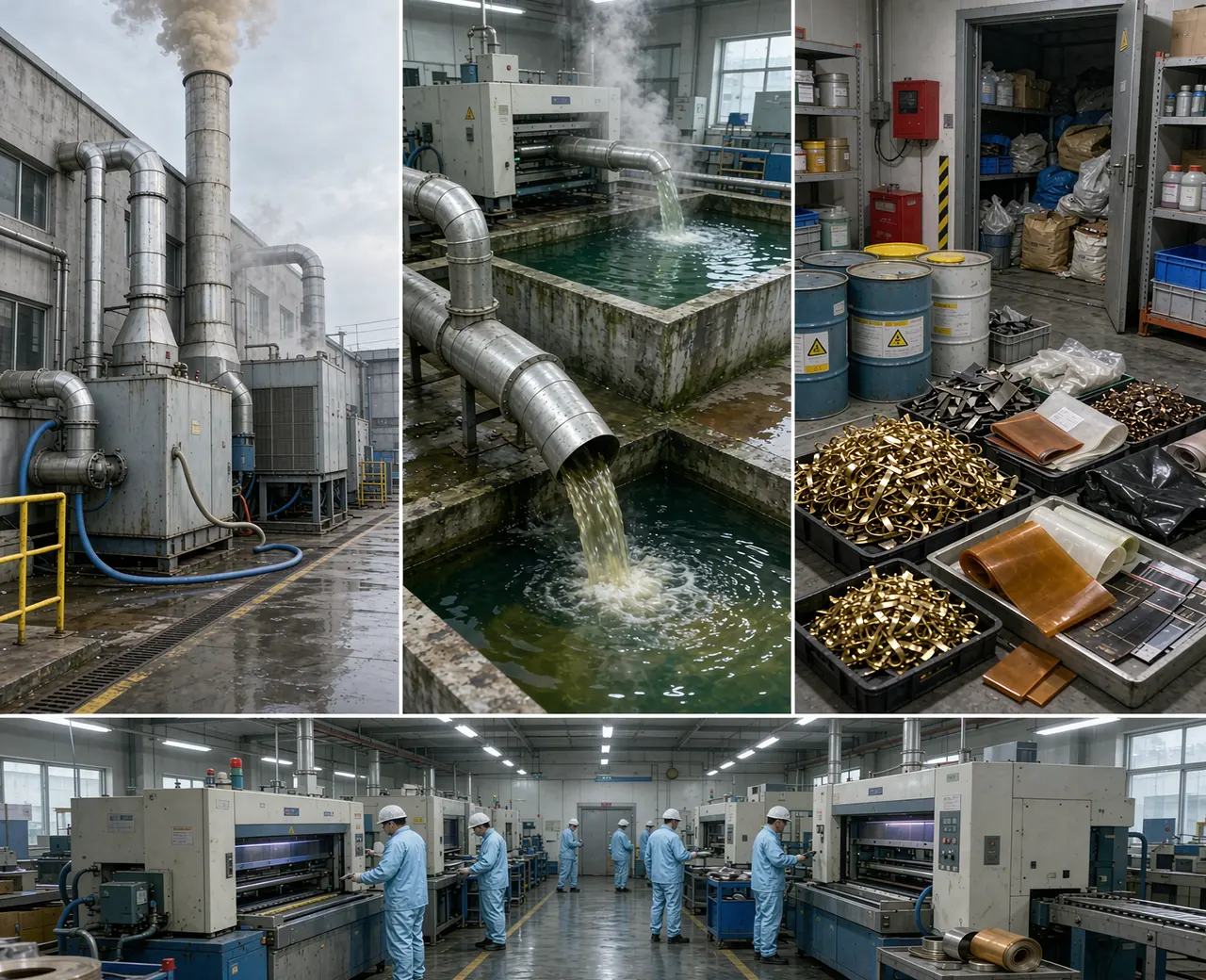
FPC exhaust gas treatment advanced solutions combine multi-stage wet scrubbing, acid mist separation, and VOC or thermal oxidation. They capture fumes from etching, plating, and lamination lines in flexible circuit plants. These systems hold hydrogen chloride, acid mist, and solvents below local emission limits. They also protect the fine-line yield that flexible circuit production depends on.

Flexible circuits are built on thin polyimide films with very fine copper traces. Therefore, the process chemistry is aggressive, and the substrate is fragile. A weak exhaust system creates two problems at once: failed compliance tests and contamination defects on the panel. The sections below explain what modern FPC exhaust gas treatment advanced solutions look like in practice.
Which pollutants does an FPC plant exhaust?

Which pollutants does an FPC plant exhaust?
FPC fabrication covers many wet and dry steps. Also, each step releases a different mixture. Typical streams include:
- Etching and desmearing – hydrochloric acid mist, sulfuric acid mist, and fluoride compounds.
- Electroplating and chemical plating – acid mist, metal aerosols, and alkaline vapour.
- Coverlay lamination and curing – organic vapours from epoxy and acrylic adhesives.
- Solder mask printing – glycol ethers, IPA, and other solvents.
- Laser drilling and cutting – polyimide soot and sub-micron particles.
Because these streams differ, a single technology rarely meets the limit. Instead, plants usually combine two or three stages in series.
What are the advanced treatment technologies?
Multi-stage wet scrubbing
A packed-bed tower absorbs water-soluble gases, and an alkaline dosing loop neutralises acids. Next, a mist eliminator stops droplets from leaving the stack. For high-fluoride etching, a venturi stage adds extra contact time. Removal efficiency for HCl and HF typically reaches 95–99% when pH stays in range.
Wet electrostatic precipitation (WESP)
WESP units charge and collect fine mist that packed beds miss. Therefore, they suit plating lines with heavy metal aerosol. However, they need clean water and regular electrode washing.
Activated carbon and impregnated media
Carbon adsorbs solvents, odours, and trace organics. Impregnated grades also capture acid gases and ammonia. In addition, on-site regeneration keeps operating costs down on high-load lines.
Thermal and catalytic oxidation
RTO and TO units destroy VOCs from lamination and curing ovens at 760–850 °C. Catalytic oxidation runs at 300–400 °C but needs a poison-free stream. Heat recovery cuts fuel use, yet the footprint and capital cost are higher.
Condensation and plasma
Condensers recover high-boiling solvents before the main scrubber. Also, plasma and UV units polish low-concentration odours at low cost. They work best as a final stage, not as the primary control.
How do you match the solution to each process step?
Match the stage to the pollutant, not to the plant budget. For example:
| Process | Main pollutant | Recommended train |
|---|---|---|
| Acid etching / desmear | HCl, HF mist | Two-stage alkaline scrubber + demister |
| Copper plating | Acid mist, metal aerosol | Packed scrubber + WESP |
| Coverlay lamination | VOC, amine | RTO, or carbon + heat recovery |
| Solder mask printing | Solvent vapour | Carbon adsorption + polishing |
| Laser drilling | Soot, particles | Cyclone + HEPA + carbon |
Then verify capture at the hood before sizing the tower. A 90% efficient scrubber cannot fix a 50% capture rate.
Selection checklist for advanced systems
- Capture at source with local hoods and low face velocity.
- Choose corrosion-proof materials: PP, FRP, PVDF, or stainless for hot streams.
- Control pH and dosing automatically, with alarms and data logging.
- Keep pressure drop low to cut fan energy.
- Add redundancy on critical lines, because a shutdown stops the whole reel.
- Plan maintenance access and consumable replacement from day one.
- Install continuous monitoring (CEMS) for regulated parameters.
Compliance, energy, and real cost
Regulators now treat VOC and acid mist as separate limits. Therefore, plants in China, Taiwan, and Southeast Asia must report both. ISO 14001 audits also expect calibration records and trend data. In addition, energy is often the highest running cost, because fans and burners run continuously.
Cost matters at panel level. Buyers who compare flexible PCB price per square inch rarely see treatment cost directly. However, it sits inside overhead, so efficient systems protect margin. For instance, heat recovery on an RTO can cut fuel use by half or more.
Demand changes the picture too. Growth in FPC in Electric Vehicles pushes plants toward higher plating capacity and larger exhaust volumes. Meanwhile, designers keep shrinking trace width, so particle control becomes a quality issue, not only a compliance issue.
Where treatment quality shows up in the product
Clean exhaust supports clean production. That matters for sensitive builds such as Sensor FPC for fingerprint and camera modules, where surface contamination causes open circuits. It also supports high-density Transfer FPC used between boards and battery packs.
Flexible PCB Application Solutions often need multiple lamination and plating cycles. Each cycle adds exhaust load. Therefore, plan treatment capacity against the product roadmap, not just current output.
Connector areas deserve attention as well. Plating baths for a flex circuit connector’s contact pads produce some of the heaviest acid mist in the plant. Also, process chemistry shifts when you compare FFC vs FPC, so the exhaust profile changes with the product mix.
As a Flexible PCB Manufacturer, Gekunflex designs these controls into new lines from the start. That approach keeps compliance predictable and keeps yields stable.
Frequently asked questions
What is FPC exhaust gas treatment?
It is the capture and cleaning of fumes released during flexible circuit fabrication. The system collects acid mist, solvents, and particles at the source. Then it treats them with scrubbing, adsorption, or oxidation before release.
Which scrubber is best for acid mist from FPC etching?
A two-stage packed scrubber with alkaline dosing and a mist eliminator works for most etching and desmear lines. Add a venturi stage when fluoride compounds are present, because extra contact time improves HF removal.
Does exhaust treatment raise flexible PCB cost?
It adds capital and energy cost, mostly through fans and burners. However, good capture reduces rework and scrap. Therefore, the net cost per good panel often falls rather than rises.
What removal efficiency should I expect?
Well-designed wet scrubbers reach 95–99% for water-soluble acid gases. RTO units typically destroy 95–99% of VOCs. Actual results depend on capture efficiency, pH control, and maintenance discipline.
Do laser and lamination stages need separate systems?
Not always, but they need different stages. Laser dust suits cyclone and HEPA filtration, while lamination VOCs suit thermal or carbon treatment. Sharing one duct line usually causes blockages and poor results.
Next step
Send your process list, airflow figures, and target limits to our engineering team. We will size a treatment train that fits your line and your product roadmap. You can also review our Flexible PCB Application Solutions while you prepare the data.
Related Posts
- Choosing the Right Flex Circuit Connector | Gekun — Related article
- FFC vs FPC: Key Differences and How to Choose — Related article
- FPC in Electric Vehicles Guide — Related article
- Flexible PCB Cost 2026: Price Per Sq.Inch & Calculator — Related article
- Flexible PCB Cost Guide — Related article