
Plated and Non-Plated Through Hole: PTH vs NPTH Design Guide
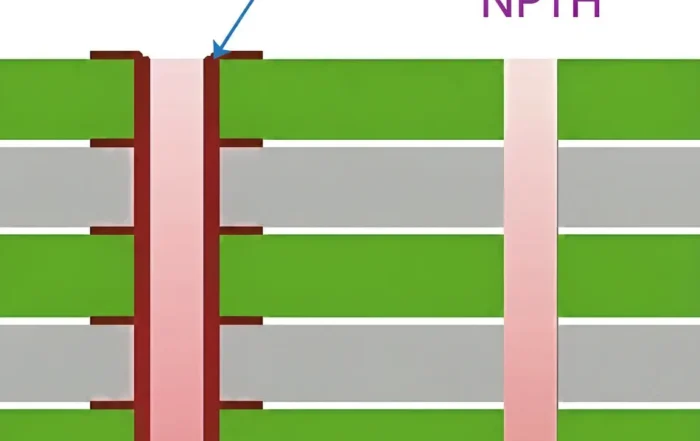
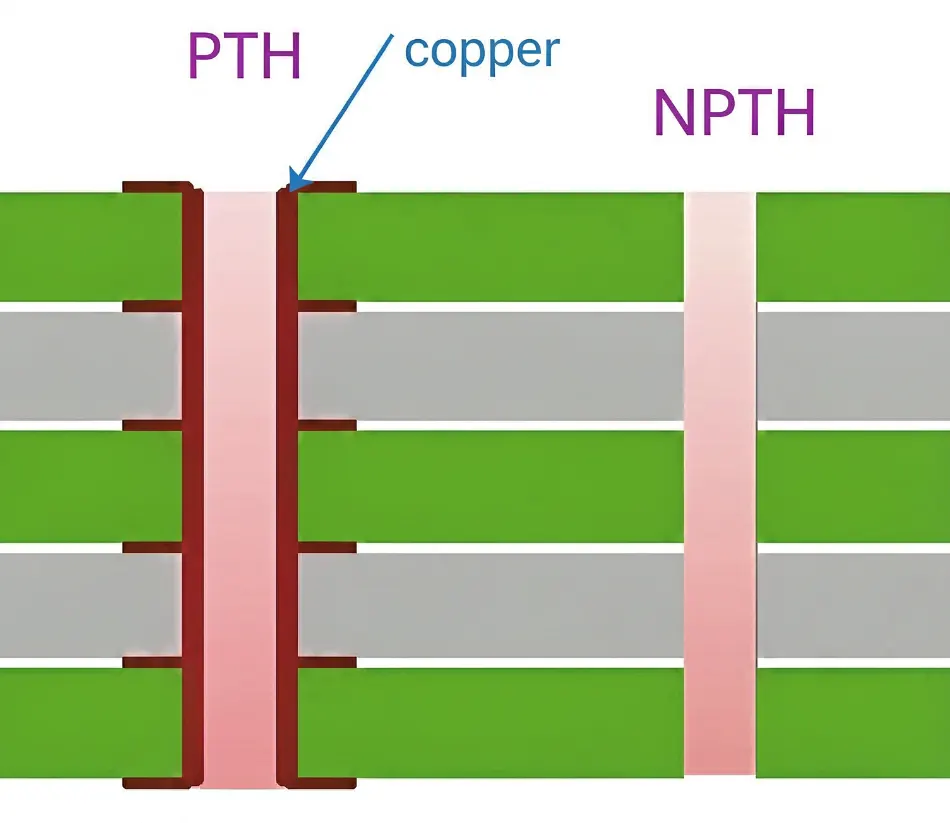
A plated through hole (PTH) carries a conductive copper wall that links board layers. A non-plated through hole (NPTH) is drilled but left bare, so it serves mechanical needs only. Both pass through the full board thickness, and the spelling ‘thru-hole’ means the same thing.
See also Flexible PCB Manufacturer for related specifications.
See also Rigid-Flex PCB for related specifications.
See also Rigid-Flex PCB Technology for related specifications.
See also PCB Manufacturing FAQ for related specifications.
The choice between them affects electrical yield, mechanical strength, and price. This guide compares both types, walks through the manufacturing flow, and gives you a simple decision path.
What Do Plated and Non-Plated Through Holes Mean?
A through hole is a drilled opening that runs from the top to the bottom of the board. The wall surface is what separates the two families.
- Plated Through Hole (PTH): the barrel wall carries electroplated copper. That copper connects pads, inner layers, and component pins.
- Non-Plated Through Hole (NPTH): the barrel wall stays bare laminate. The hole provides clearance, alignment, or fastening.
Therefore, the key question is simple. Does the hole need to conduct current, or does it only need to hold something?
PTH vs NPTH: Side-by-Side Comparison
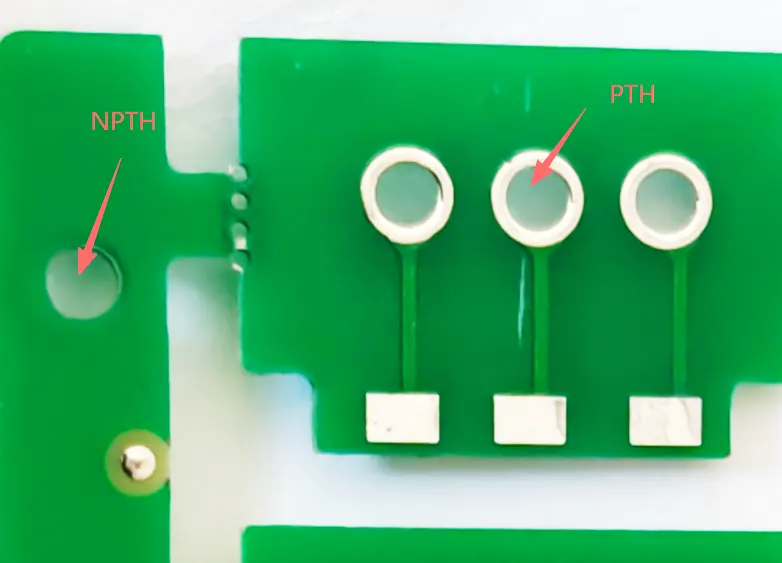
PTH VS NPTH
| Feature | Plated Through Hole (PTH) | Non-Plated Through Hole (NPTH) |
|---|---|---|
| Barrel wall | Copper plated, typically 20–25 µm | Bare laminate, no copper |
| Electrical connection | Yes, links layers and pads | No |
| Main function | Interconnect, component pins, vias, test points | Mounting, alignment, screw and standoff clearance |
| Pad / annular ring | Required on every connected layer | Not required; keep-out instead |
| Relative cost | Higher: extra plating and inspection steps | Lower: drill and deburr only |
| Typical failure risks | Barrel voids, barrel cracks, solder wicking | Hole-wall cracks, crazing, copper pull-back at the rim |
| Common uses | Through-hole parts, connectors, vias, probes | Screw holes, locating pins, standoff holes, access holes |
Plated Through Holes (PTH): Function, Pros, and Limits
Plated holes form the electrical backbone of a multi-layer board. The plating step deposits copper inside the drilled barrel, then the surface copper ties that barrel to each pad.
Advantages
- Provides reliable layer-to-layer conductivity, including on flexible and rigid-flex builds.
- Supports through-hole component leads with strong solder joints.
- Allows smaller vias, which frees routing space on dense designs.
- Gives test points and connector pins a durable, repeatable contact surface.
Limitations
- Adds plating, imaging, and inspection steps, so unit cost rises.
- Thin barrels can crack under thermal cycling or repeated bending.
- Poor hole-wall quality invites solder wicking and voiding.
In addition, plating quality varies with hole aspect ratio. Deep, narrow holes are harder to plate evenly, so specify the barrel thickness you actually need.
Non-Plated Through Holes (NPTH): Function, Pros, and Limits
Non-plated holes do the mechanical work. A screw, a standoff, or an alignment pin passes through, and no current flows.
Advantages
- Lower cost, because the hole skips copper plating and related inspection.
- Clean, predictable clearance for hardware and tooling pins.
- No electrical short risk against nearby traces when the keep-out is respected.
- Simple to add late in the design without touching the electrical netlist.
Limitations
- Zero electrical function, so it cannot act as a ground or a shield tie.
- The bare wall is mechanically weaker under press-fit and rotation stress.
- Rough drilling or chattering can leave micro-cracks that grow during assembly.
- Oversized hardware can crush the rim and lift nearby copper.
For example, a press-fit standoff that rotates during torque can split an unplated wall. A plated hole with a proper annular ring resists that load far better.
Complete Manufacturing Flow: Drill → Deburr → Electroless Copper → Electroplate → Plug/Tent
The two hole types share front-end drilling and cleaning, then diverge at copper deposition and finishing. A robust fabrication note links each step to the hole type so the shop does not plate a hole that should stay bare.
1. Drill the hole pattern. CNC drilling uses one program for PTH and NPTH where possible. For critical NPTH, some shops drill after plating or finish the hole by routing so the wall remains laminate.
2. Deburr and desmear. Mechanical brushing removes burrs; chemical desmear removes resin smear after drilling, especially on high-aspect-ratio holes. Clean walls are required before any copper seed.
3. Electroless copper seed. A thin, conformal copper layer is deposited chemically over the panel. At this stage even NPTH walls may receive seed copper, so the downstream resist pattern and drill sequence must protect the final intent.
4. Imaging and pattern electroplating. Dry film defines the circuits and PTH barrels. Electroplating builds copper in the hole to the specified barrel thickness; NPTH areas are either masked or drilled later. For related process detail, see PCB Copper Plating.
5. Strip, etch, and NPTH release. After plating, resist is stripped and copper etched. NPTH may be re-drilled, routed, or countersunk at this point to guarantee a bare, clean wall.
6. Solder mask tenting, plugging, and surface finish. Vias can be tented with mask, plugged and capped, or left open. Mechanical NPTH holes normally remain open and clear of mask and finish.
The order matters. If a shop plates first and drills later, the NPTH wall is guaranteed bare. That is why fabrication notes should state the hole type and the plating intent for every hole.
DFM Rules: Annular Ring, Tolerances, and Keep-Outs
Use these practical limits as a starting point, then confirm with your fabricator.
- Annular ring: 0.05 mm (2 mil) minimum for standard builds; 0.075–0.1 mm for high-reliability work.
- Drill tolerance: about ±0.075 mm (0.003 in) for standard mechanical drilling.
- NPTH clearance: keep 0.25–0.5 mm from nearby copper, and never route a trace tangent to the rim.
- Barrel copper: IPC-6012 Class 3 typically calls for 25 µm average with a 20 µm minimum in the hole.
- Aspect ratio: above roughly 8:1, plating uniformity becomes harder, so add process notes.
- Hole-to-hole spacing: leave at least one hole diameter of web between holes to avoid breakout.
Also flag any hole that is copper-plated but not connected. Ambiguous intent is the most common source of wrong builds.
Electrical Reliability, Mechanical Stress, and Failure Modes
Reliability separates the two types more than price does.
PTH risks
- Plating voids and thin knees at the barrel-to-pad junction.
- Barrel cracks after thermal cycling, especially on thick boards.
- Solder wicking into the barrel, which steals solder from the joint.
NPTH risks
- Chipped or cracked walls from drill chattering.
- Rim cracks under press-fit inserts and torque loads.
- Copper pull-back when a screw head lands too close to a pad.
Therefore, run PCB hole wall quality inspection on first articles. A quick cross-section tells you whether the barrel is fully plated, voided, or cracked. On flexible and rigid-flex designs, pair that check with the plating and pad stack review covered in our HDI rigid-flex PCB process notes.
Cost Comparison: Where the Money Goes
A plated hole costs more than a bare hole, and the gap comes from process steps rather than drill time.
- Plating adds electroless copper, pattern plating, and thickness control.
- Inspection adds cross-sectioning and hole-wall checks on samples.
- Yield loss rises with fine annular rings and high aspect ratios.
In practice, converting a mounting hole from NPTH to PTH rarely changes a quote much. Converting hundreds of vias, however, adds real cost. For the full breakdown of panel, layer, and process drivers, see our guide to flexible PCB cost factors.
How to Choose: A Three-Question Decision Path
Work through these questions in order.
1. Does the hole carry current or connect layers? If yes, it must be plated.
2. Does the hole take mechanical load or alignment? If yes and no current flows, use NPTH with a proper keep-out.
3. Is the design cost-sensitive or space-constrained? Bare holes save process steps; plated holes save routing space.
If the answer is unclear, plate the hole and add a note. A short DFM review with the fabricator is cheaper than a re-spin.
Selection Checklist: Electrical Connection → Load → Cost Sensitivity
Use this checklist as a selection flow, not as a data sheet. It keeps the decision focused on function, then cost.
| Decision order | Ask | If yes | If no |
|---|---|---|---|
| 1. Electrical connection | Does the hole need to conduct current, connect layers, or act as ground? | Choose PTH with a pad and annular ring on every connected layer. | Go to step 2. |
| 2. Mechanical load | Does it carry a screw, standoff, locating pin, or press-fit insert? | Choose NPTH if no current flows; choose PTH if the joint must resist high torque or repeated assembly. | Go to step 3. |
| 3. Cost sensitivity | Is the design cost- or process-sensitive? | Reduce plated hole count and use NPTH for non-electrical holes. | Plate only where routing space, grounding, or reliability demands it. |
Before you request a quote, prepare a hole table that marks each hole as PTH or NPTH, plus stack-up, annular ring, barrel thickness, NPTH clearance, and hardware torque or insert type. Those checkpoints let the fabricator quote the actual process and avoid a late re-spin.
Mounting Holes: Plated or Non-Plated?
Mounting holes are the most common PTH/NPTH decision. Use this rule set to choose the process intent before layout sign-off.
- Use NPTH when the screw or standoff clamps the board, no current flows, and the hole only needs clearance. Keep 0.25–0.5 mm copper clearance and size the hole for hardware tolerance.
- Use PTH when the mounting point must be grounded, when a press-fit insert or repeated torque needs a reinforced barrel, or when the hole doubles as a test or contact point.
- Use PTH with caution for plated mounting holes near board edges: add a wide annular ring and check for copper pull-back during assembly.
Mark each mounting hole as PTH or NPTH in the fabrication drawing. If the hole is plated but isolated from ground, state the clearance from the ground net; do not rely on an NPTH to provide electrical isolation.
FAQ
Can I convert an NPTH into a PTH?
Yes, at layout and fabrication level. Add pads and an annular ring on every connected layer, then tell the fabricator the hole is plated. In production, the panel must be replated or redrilled, so treat it as a new build.
Can a non-plated hole be grounded?
No. A bare wall has no copper, so it cannot carry ground. If you need a chassis or shield tie, use a plated hole with a dedicated ground pad and a wide annular ring.
How much does NPTH vs PTH affect cost?
A single hole changes little. The difference scales with hole count, aspect ratio, and annular ring size, because plating and inspection are per-panel steps. Sparse, large mechanical holes are the cheapest option.
When should I use a non-plated hole for mounting?
Use NPTH for screws, standoffs, and locating pins where no current flows and the hardware clamps the board. Add 0.25–0.5 mm copper clearance and keep the rim away from traces.
What annular ring do I need for a plated hole?
0.05 mm (2 mil) is a common minimum. For Class 3, automotive, or repeated thermal cycling, ask for 0.075–0.1 mm to absorb drill drift and keep the barrel-to-pad junction intact.
Summary / Key Takeaways
- PTH conducts; NPTH fastens. That single difference drives the rest.
- PTH costs more but delivers electrical connection and better load tolerance.
- NPTH saves process steps and needs a clean copper keep-out.
- Drill order decides whether an NPTH wall truly stays bare.
- Specify the hole type and plating intent on every fabrication drawing.
Before you release the Gerbers, send us your stack-up and hole table. Our engineering team will review annular rings, plating thickness, and NPTH clearances, then quote a build that matches your reliability target.
Related Posts
- Nickel-Gold Plated FPC Component Detachment Failure Analysis — Related article
- PCB Copper Plating Process — Related article
- PCB Hole Wall Quality Inspection: Methods, Criteria & Fixes — Related article
- Crimp Terminals for FPCB Connectors: Experimental Study — Related article
- Flexible PCB Cost Guide — Related article