How Are Fully Recyclable Flexible PCBs Made?
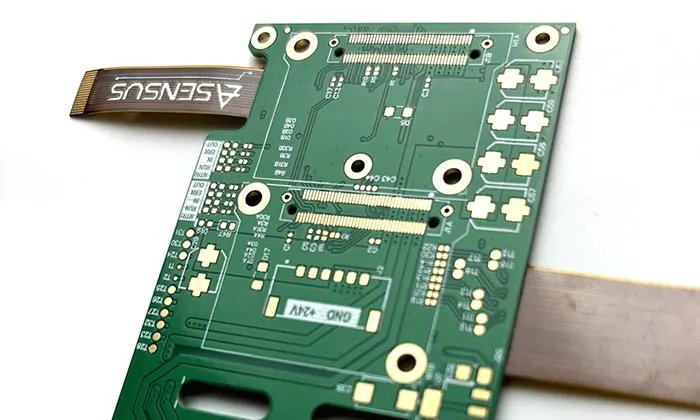
With the widespread use of electronic devices, waste electrical and electronic equipment (WEEE) has become a major challenge for global environmental management.
Statistics show that the world generated approximately 53.6 million metric tons of electronic waste in 2019, and this figure is projected to surge to 243 million metric tons by 2050.
As a core component of electronic devices, printed circuit boards (PCBs) pose significant recycling challenges due to their composition of various materials, including polymer substrates, metal circuits, and electronic components.
Traditional mechanical recycling methods struggle to separate the complex components within PCBs, while chemical recycling often requires harsh conditions or catalysts that may damage metal components.
To address this challenge, a team led by Professor Sun Junqi at Jilin University has developed a novel PCB material based on reversibly cross-linked polymers.
The material demonstrates exceptional mechanical properties and flexibility.
It also enables closed-loop recycling, allowing manufacturers to efficiently separate it from mixed plastic waste and regenerate it into high-purity raw materials.
This research provides an innovative solution for the sustainable management of electronic waste.
Ingenious Design of Reversibly Cross-Linked Polymers: When PMMA Meets PUU
Starting with molecular design, the research team selected two functionalized polymers as the basic building blocks: phenylboronic acid-modified poly (methyl methacrylate) (PMMA-B) and phenylboronic acid-capped polyurea-polyurethane (PUU-B).
These two polymers play complementary roles: PMMA-B provides a rigid support, while PUU-B imparts flexibility to the material.
The researchers cross-linked the two polymers through dynamic covalent bonds, specifically boron-oxirane rings, to create a composite material called PMMA-PUU.
This cross-linking approach relies on reversible bonding behavior: boron-oxirane rings remain stable at room temperature but can break down reversibly in alcohol solvents, enabling subsequent material recovery.
The research team optimized the material’s properties by precisely controlling the ratio of PMMA-B to PUU-B (ranging from 1:0.5 to 1:0.7).
Among these, PMMA-PUU0.6 (mass ratio 1:0.6) exhibited the best balance: small-angle X-ray scattering revealed the presence of phase-separated microdomains within the material; this nanoscale structure acts as a natural reinforcing agent, further enhancing mechanical strength.
Fourier transform infrared spectroscopy verified the successful formation of boron-oxa-hexacyclic rings.
The material also showed good macroscopic uniformity, enabling manufacturers to produce films with dimensions of 20 × 30 centimeters.
This correlation between molecular-level design and macroscopic performance demonstrates the researchers’ deep understanding of the structure-property relationship in materials.
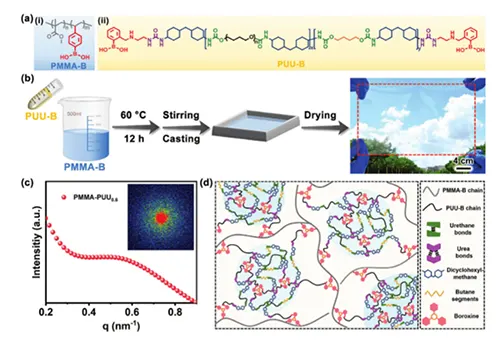
Fig. 1: a) Chemical structures of PMMA-B and PUU-B. b) Schematic illustration of the preparation of PMMA-PUU composites. The digital image in (b) shows a PMMA-PUU0.6 composite sheet with dimensions of 20 cm × 30 cm. c) SAXS profile of the PMMA-PUU0.6 composite; the inset shows the 2D-SAXS image of the PMMA-PUU0.6 composite. d) Schematic illustration of the structure of the PMMA-PUU composite.
Beyond Traditional Mechanical Properties: The Perfect Balance of Strength and Flexibility
Conventional recyclable plastics often sacrifice mechanical strength in exchange for degradability, but PMMA-PUU 0.6 breaks through this limitation.
Tensile tests show that it has a tensile strength of up to 71.0 MPa and a Young’s modulus of 1.8 GPa, far exceeding most reported closed-loop recyclable materials.
A film just 0.2 millimeters thick can support a weight of 5 kilograms without breaking, demonstrating its combination of high strength and flexibility.
Thermogravimetric analysis indicates that the material does not begin to decompose until 283.6 °C, and differential scanning calorimetry measures a glass transition temperature of 118.2 °C, meeting the operating temperature requirements for electronic devices.
Even more remarkable is the material’s self-healing capability.
When cut, the material requires only brief immersion in a dimethyl sulfoxide/ethanol mixed solvent followed by exposure at 60 °C for 6 hours for the cut to disappear completely and its mechanical properties to be fully restored.
This property stems from the ability of dynamic boron-oxygen bonds and hydrogen bonds to reorganize: the solvent temporarily disrupts the cross-linked network, allowing polymer chains to migrate, and the cross-links reform after evaporation.
This design significantly enhances the product’s service life and reliability, offering new insights into the durability of flexible electronic devices.
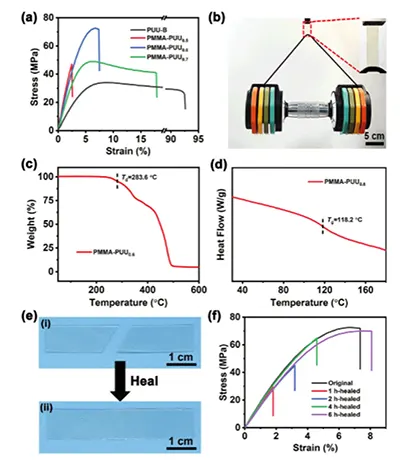
Fig. 2: a) Stress-strain curves of PUU-B and three types of PMMA-PUU plastics at different PMMA-B/PUU-B mass ratios. b) Digital image showing that a PMMA-PUU0.6 plastic sample (0.2 mm thick, 0.5 cm wide) can support a weight of 5 kg. c,d) TGA (c) and DSC (d) curves of PMMA-PUU0.6 plastic. e) Digital images showing a PMMA-PUU0.6 plastic strip cut in half (i) and subsequently fully healed (ii). f) Stress-strain curves of PMMA-PUU0.6 plastic after separation and at various healing times.
Implementation of Closed-Loop Recycling: Molecular-Level Dissociation and High-Purity Regeneration
The true innovation lies in the material’s ability to undergo closed-loop recycling.
Researchers placed PMMA-PUU0.6 fragments in a dimethyl sulfoxide/ethanol mixed solvent; under mild conditions, the boronoxacyclohexane dissociated, and the material completely depolymerized into PMMA-B and PUU-B polymer chains.
Researchers achieved efficient separation through selective precipitation by exploiting the difference in ethanol solubility between the two components: PMMA-B remains insoluble, while PUU-B dissolves.
The recovered polymers were verified by NMR and IR spectroscopy to have chemical structures identical to the original material, with their molecular weight distributions remaining unchanged (Figure 3).
High Recovery Efficiency Across Multiple Recycling Cycles
The recovery process supports more than three recycling cycles, maintaining recovery rates above 90% for both PMMA-B and PUU-B in each cycle.
This high efficiency is attributable to the carefully designed molecular structure:
The polymer chains have moderate molecular weights (approximately 20.6 kDa for PMMA-B and 4.9 kDa for PUU-B), and there is minimal chain entanglement between crosslinking sites, making the chain segments easy to separate after depolymerization.
Monomer-Level Regeneration Sets a New Standard
Unlike conventional plastic downcycling, this method achieves true “monomer-level” regeneration, setting a new benchmark for polymer waste management (Figure 4).
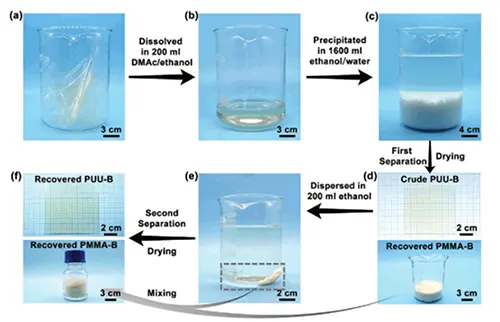
Fig 3. Closed-loop recycling of PMMA-PUU0.6 plastic. a) PMMA-PUU0.6 plastic part. b) Dissolution of the plastic piece in a DMAc/ethanol mixed solvent. c) Dropping the mixed solution from (b) into an ethanol/water mixed solvent. d) PMMA-B and crude PUU-B obtained after the first separation. e) Dispersion of crude PUU-B in ethanol. f) PMMA-B and PUU-B recovered after the second separation step.
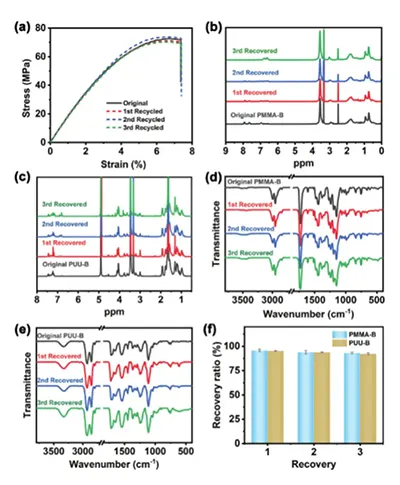
Fig. 4: Multi-cycle closed-loop recycling of PMMA-PUU0.6 plastic. a) Stress-strain curves of pristine PMMA-PUU0.6 plastic and samples recovered after the first, second, and third cycles. b-e) ¹H NMR spectra (b, c) and FT-IR spectra (d, e) of pristine PMMA-B and PUU-B and those recovered after 1, 2, and 3 cycles. f) Summary of recovery yields for the polymers across three cycles. Error bars represent the standard deviation of three independent measurements.
From Materials to Devices: The Green Revolution in Flexible PCBs
The research team further applied this polymer to PCB manufacturing.
The conductive silver paste, prepared by combining silver particles with a PMMA-B/PUU-B composite, exhibits shear-thinning properties—its viscosity decreases during printing to facilitate shaping, and then returns to its original viscosity after printing to maintain the shape.
The paste flows easily during stencil printing, enabling precise formation of circuit patterns.
PMMA-PUU0.6-based flexible PCBs withstand repeated bending without damage. They also operate normally when connected to a calculator (Figure 5).
Self-Healing Restores Circuit Functionality
If the circuit board becomes damaged, its self-healing capability restores its functionality.
A solvent repairs the severed circuit, and the resistance returns to its original value. This recovery confirms that the circuit has regained electrical continuity.
This reparability reduces electronic waste, and even more revolutionary is the PCB’s full recyclability.
Closed-Loop Recycling Enables Sustainable PCB Manufacturing
The entire circuit board can be dissociated in dimethyl sulfoxide/ethanol; the process separates and recovers the silver particles through precipitation while regenerating the polymer solution as raw material.
The morphology of the recovered silver particles is identical to that of the original material, and the remanufactured PCB exhibits no loss of conductivity, thereby achieving a closed-loop resource utilization cycle (Figure 6).
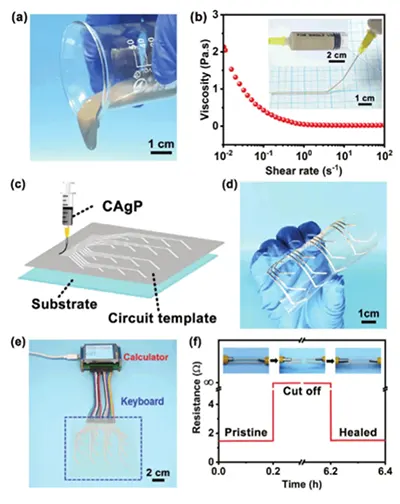
Fig 5. Fabrication and repair of flexible PCBs. a) Digital image of CAgP with a viscosity of 2.25 Pa·s. b) Rheological curve showing the viscosity of CAgP as a function of shear rate; the inset shows CAgP being extruded from a syringe. c) Schematic diagram of the fabrication of a keyboard-style flexible PCB. d) Digital image demonstrating the flexibility of the keyboard-style PCB. e) Digital image of the keyboard-style PCB operating a calculator. f) Real-time resistance changes of the PMMA-PUU0.6-based PCB during cutting and healing processes; the inset shows digital images of the original PCB, the PCB cut in half, and the fully healed PCB.”
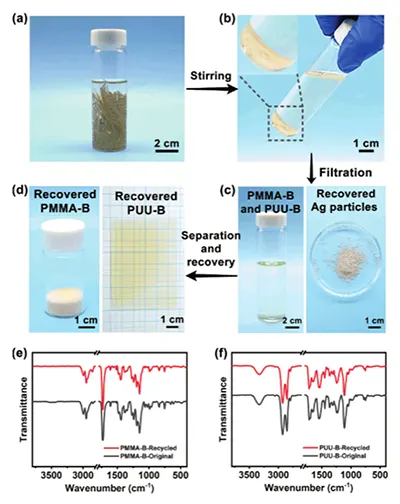
Fig 6. Recycling process of the flexible PCB. a) Vial containing flexible PCB pieces and a DMAc/ethanol mixed solvent. b,c) Depolymerization of the PMMA-PUU plastic yields precipitated Ag particles and a DMAc/ethanol solution of PMMA-B and PUU-B. d) Recovered PMMA-B and PUU-B. e,f) FT-IR spectra of e) PMMA-B and f) PUU-B recovered from the flexible PCB.
Tackling Complex Waste Streams: A Smart Solution for Precise Separation
To validate the method’s practical application potential, researchers simulated the most challenging scenario: mixing PCBs with seven common plastics (such as PET, PVC, etc.).
Through a two-step solvent-based process—first dissolving some of the plastics with tetrahydrofuran, then treating the remaining mixture with dimethyl sulfoxide/ethanol—they successfully separated the PCB components.
The purity of the recovered silver particles, PMMA-B, and PUU-B was comparable to that achieved with single-material recycling, demonstrating the method’s adaptability to complex waste streams.
This selective recovery capability stems from a dual-pronged approach in material design: on the one hand, PMMA-PUU dissociates only upon contact with alcohol-based solvents, preventing co-dissolution with other plastics; on the other hand, differences in the affinity of polymers and metals for each other facilitate the separation of silver particles.
This approach overcomes the raw material purity requirements of traditional recycling technologies and provides a new paradigm for the sorting and processing of electronic waste.
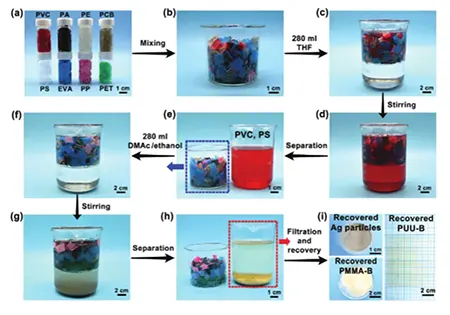
Figure 7. Selective separation of PCBs from a mixed polymer waste stream.
Conclusion
This study achieves a balance between material performance and sustainability through molecular-level design.
The PMMA-PUU polymer not only possesses mechanical properties comparable to those of traditional engineering plastics but also pioneers the first fully closed-loop recycling process for PCBs.Its reparable nature extends product lifespan, while its compatibility with other waste materials enables efficient co-recycling and significantly enhances practical feasibility.