Adhesive-Free FCCL Substrates vs Adhesive-Based Substrates: 2L-FCCL vs 3L-FCCL Performance
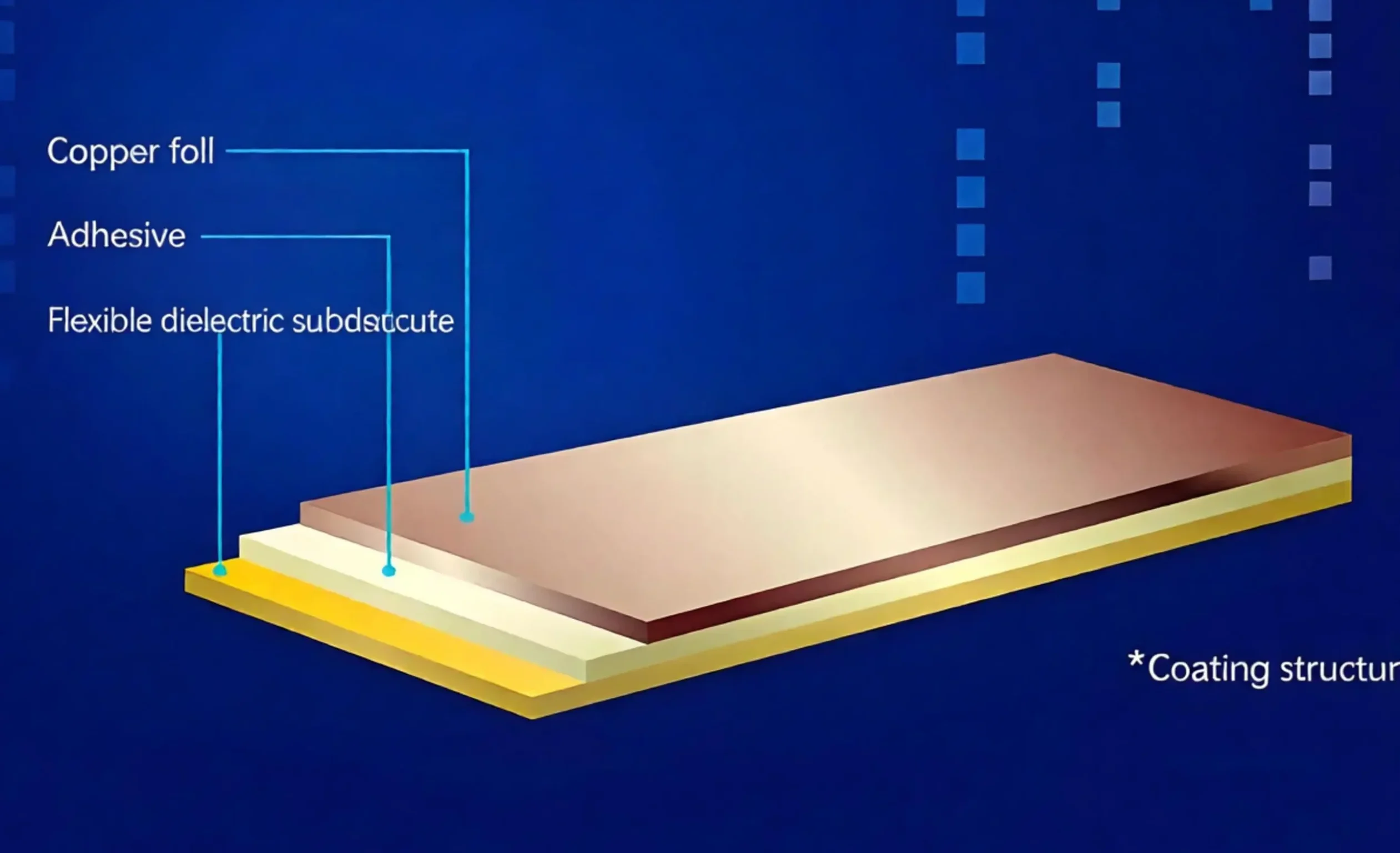
Adhesive-Free FCCL Substrates bond polyimide (PI) directly to copper foil with no adhesive layer. Because the adhesive is removed, a 2L-FCCL avoids the CTE mismatch and internal stress that a 3L-FCCL shows. Therefore, adhesive-free vs. adhesive-based FCCL performance differs most in stability, thickness, and heat resistance.
< div class=”mceTemp”>
What Are Adhesive-Free FCCL Substrates?
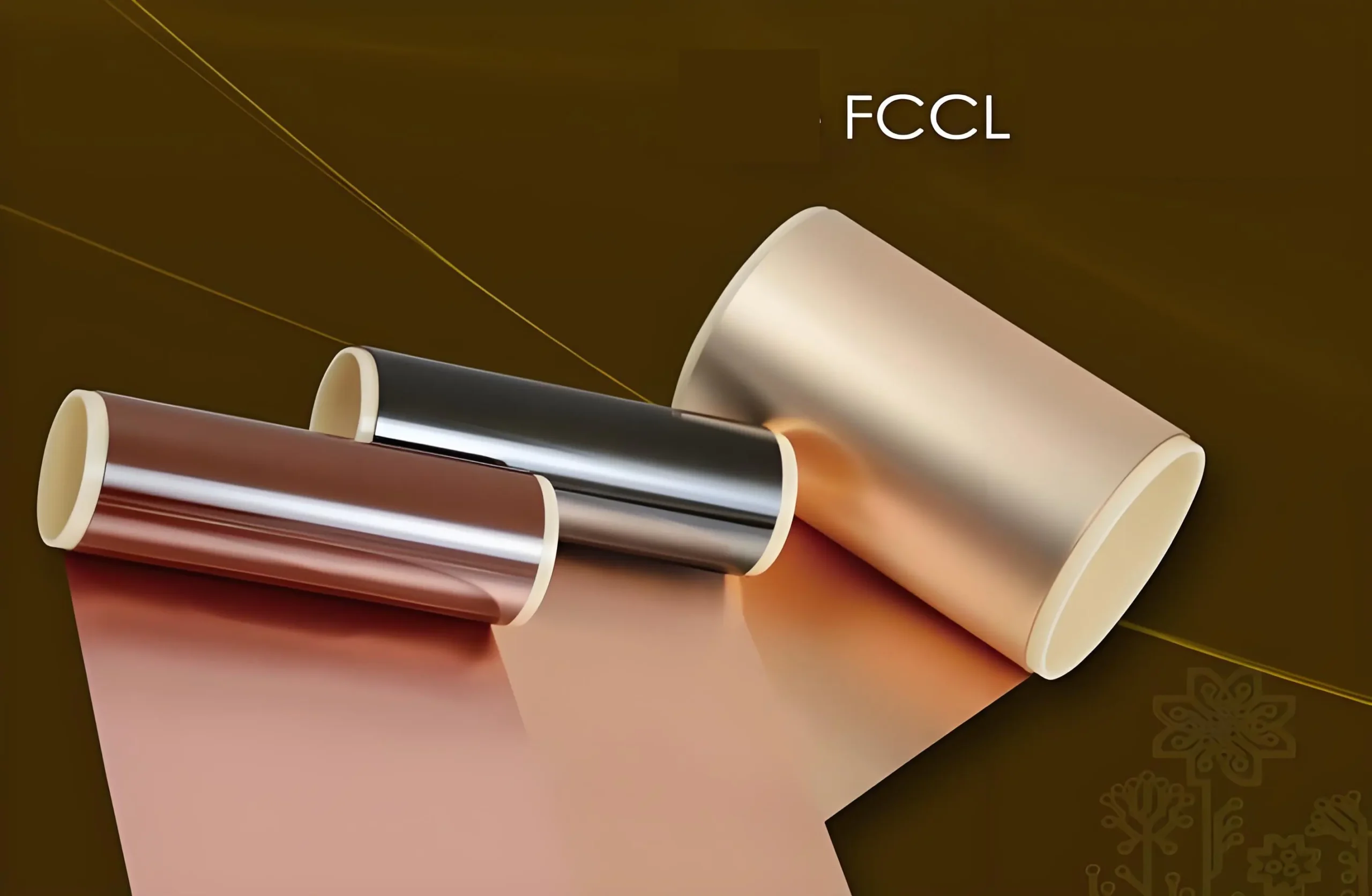
An FCCL substrate is the copper-clad base that carries an FPC. The industry splits these substrates into two families. One family uses an adhesive layer, and the other does not. Adhesive-Free FCCL Substrates use only polyimide (PI) film and copper foil. As a result, the copper bonds directly to the PI.
Adhesive-Free vs Adhesive-Based FCCL: How the Layers Differ
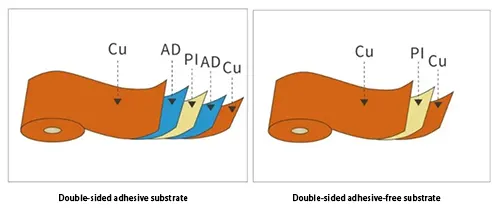
Adhesive-based substrates use a three-layer build. They stack PI film, an adhesive (AD), and copper foil. Coating, pressing, and baking form this stack. The adhesive is usually an epoxy resin or an acrylic adhesive.
Adhesive-free substrates drop that middle layer. They keep only PI and copper. Therefore, the layer count falls from three to two. That single change drives most of the performance gap.
2L-FCCL vs 3L-FCCL Performance: Key Differences
The adhesive layer is the main source of difference. Its coefficient of thermal expansion (CTE) does not match PI and copper foil. During temperature changes, the board builds internal stress. Over time, this stress can hurt reliability.
A 2L-FCCL has no adhesive layer. So the CTE mismatch between adhesive and copper disappears. Also, the stack is thinner. In addition, the PI-to-copper bond is direct rather than glued.
Stability
Adhesive-based 3L-FCCL boards are prone to internal stress when temperature changes. Adhesive-free 2L-FCCL boards remove that specific mismatch. Therefore, the adhesive-related stress source is gone from the design.
Thickness and Flexibility
An adhesive layer adds thickness. Removing it gives a thinner laminate. A thinner laminate bends more easily, which matters for tight FPC routing.
Coating Method: Building PI Directly on Copper
The coating method applies a liquid polyacrylamide (PAA) precursor solution to the copper foil surface. High-temperature baking then triggers an imidization reaction. This reaction forms a solid PI film in place on the copper foil.
The process is fairly simple. For example, it suits single-sided flexible circuits well.
Lamination Method: Bonding TPI Film to Copper
The lamination method uses a specially treated thermoplastic polyimide (TPI) film. Under high temperature and high pressure, the TPI film melts and flows. It fills the microscopic gaps on the copper foil surface. When it cools, the TPI and copper mechanically interlock.
This method is widely used today. Many leading FPC manufacturers rely on it to build high-quality adhesive-free substrates.
Advantages and Limits of Each Substrate Type
Adhesive-based substrates offer clear benefits. Their process is simple and low cost. However, they suit fast-moving consumer electronics with minimal reliability requirements.
Adhesive-free substrates target a stronger bond. The core goal is a strong PI-to-copper bond without traditional adhesives. So they fit FPCs that must survive heat and bending.
How to Choose the Right FCCL Substrate
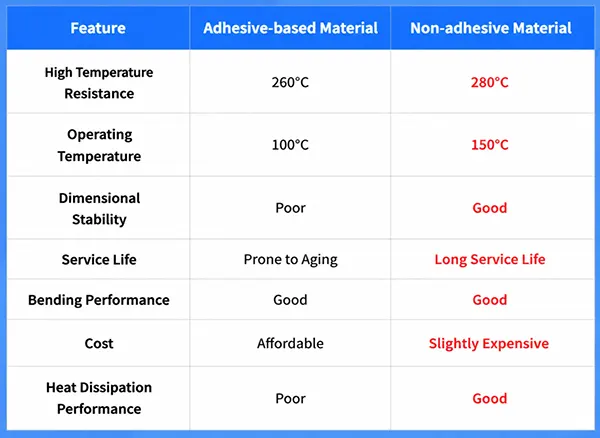
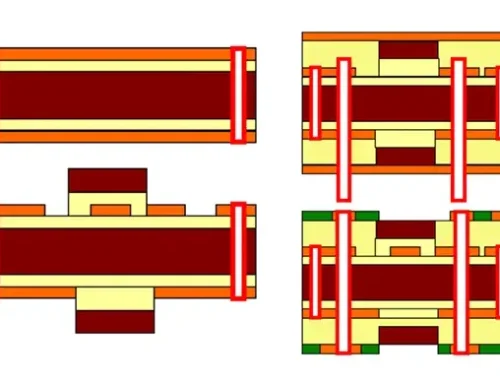
Difference between adhesive-backed and non-adhesive-backed FPC substrates
Start with the reliability target. For example, low-cost consumer products with minimal reliability needs can use adhesive-based 3L-FCCL. Next, check the circuit type. Single-sided flexible circuits often match the coating method. Then, review the thermal load. If CTE-driven stress is a concern, pick an adhesive-free 2L-FCCL built with the lamination method.
FAQ
What is the difference between adhesive-free and adhesive-based FCCL?
Adhesive-based FCCL uses three layers: PI film, an adhesive (AD), and copper foil. Coating, pressing, and baking bond them. Adhesive-free FCCL uses only PI film and copper foil. Therefore, the adhesive-free type removes the adhesive layer and bonds PI directly to copper.
How does 2L-FCCL vs 3L-FCCL performance differ?
A 3L-FCCL contains an adhesive layer whose CTE does not match PI and copper foil. That mismatch creates internal stress during temperature changes. A 2L-FCCL has no adhesive layer, so this stress source is absent. Also, the 2L stack is thinner.
Which processes produce adhesive-free FCCL substrates?
Two processes produce them. The coating method applies a liquid PAA precursor solution to copper foil and forms PI in situ through baking and imidization. The lamination method melts a specially treated TPI film onto copper under heat and pressure, then lets it cool and interlock.
Related Posts
- Carbon-Coated Film Evaluation for Reliable FCCL Copper Plating – GekunFlex — Related article
- Dual Laser etching FCCL — Related article
- FCCL vs. Rigid Copper Clad Laminate — Related article
- Flexible Copper-Clad Laminate Guide — Related article
- Rigid Flex PCB Manufacturing: A Process Overview – GekunFlex — Related article