
Rigid-Flex Boards Dimensional Stability: Control of Expansion and Cont

Rigid-Flex Boards Dimensional Stability: Control of Expansion and Cont
In the mass production of rigid-flex boards, dimensional expansion and contraction deviations are key process issues that affect product yield, mating accuracy, and service life. Unlike pure rigid or flexible boards, the expansion and contraction characteristics of rigid-flex boards combine the properties of both types.
The overall control logic centers on the expansion and contraction of the flexible substrate, with fine-tuning of the rigid substrate serving as a supplement.
Material selection, pretreatment processes, layout design, and the number of structural layers all directly determine the final dimensional accuracy, making these aspects both the focus and the challenge of advanced PCB production control.
Role of Flexible Substrate in Dimensional Stability
The dimensional stability of rigid-flex PCBs is primarily determined by the flexible substrate; the quality of the substrate directly determines the product’s fundamental coefficient of expansion and service life.
This is the core reason why the use of cheap, low-quality materials is strictly prohibited in production. Low-end flexible substrate materials suffer from insufficient material purity and uneven internal structure, resulting in extreme fluctuations in expansion and contraction values.
Furthermore, after undergoing multiple processes such as baking, lamination, and electroplating, they may exhibit persistent deformation, latent aging, and dimensional instability.
This not only causes dimensional deviations in the finished product to exceed acceptable limits but also triggers a series of quality issues in subsequent stages, such as lamination misalignment, trace displacement, and assembly defects.
Therefore, in the production of rigid-flex boards, priority must be given to ensuring substrate quality. By relying on the stability of high-quality materials and the added value of the manufacturing process, the risk of uncontrolled dimensional expansion and contraction can be mitigated at the source.
Process Control Principle: “Flex First, Then Rigid”
From an overall process perspective, dimensional calibration for rigid-flex boards follows the principle of “flex first, then rigid.” Dimensional adjustments to the outer layer of the rigid board must be carried out after the flex board circuit has been completed.
Final dimensional stabilization is performed only after the entire production process is finished, thereby ensuring precise dimensional matching between the rigid and flex regions.
Special Control for High-Layer Multilayer Rigid-Flex Boards
For high-tier multilayer rigid-flex boards with ten or more layers, the product structure is complex and unit dimensions vary significantly. Generic expansion and contraction parameters are completely inadequate for production requirements.
It is essential to implement a “test-per-model” control standard, individually testing the actual expansion and contraction values for each product and customizing process parameters to ensure precise dimensional alignment across the multilayer structure.
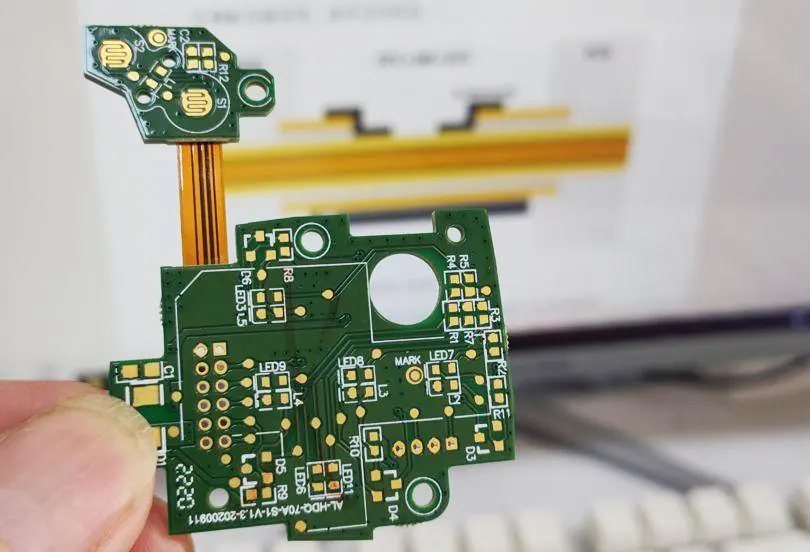
rigid flex pcb
Baking Pretreatment and Dimensional Stabilization of Standard Substrates
For standard rigid-flex boards with no special performance requirements, adhesive-free flexible substrate materials are commonly used.
The key to controlling their expansion and contraction lies in the preliminary baking pretreatment. The industry-standard baking process involves baking at a constant temperature of 120°C for 3 hours.
The primary objective is to remove residual moisture from within the board, allowing the substrate to complete stress relief and reach a state of shrinkage equilibrium in advance, thereby stabilizing the base expansion and contraction coefficient. Process parameters must be strictly controlled.
If the baking temperature is too high or the duration is too long, it will cause the PI material to age and become brittle, which not only alters the original expansion and contraction characteristics but also significantly reduces the board’s flex life and structural stability.
Material Thickness and Expansion/Contraction Behavior
At the same time, there is a negative correlation between PI thickness and expansion/contraction values; the thicker the PI, the greater the structural stability of the board and the lower the expansion and contraction coefficient.
For standard substrates with a thickness of 35 μm or less, expansion in the X direction is stable at 4–7 per 10,000, and in the Y direction at 4–8 per 10,000.
If the product requires an electroplating process, the Y-axis expansion of the board will increase significantly, typically ranging from 7 to 12 per ten thousand.
This deviation primarily stems from the material’s inherent high ductility in the Y-direction; exposure to plating solutions, electrical current, and mechanical stress further exacerbates shrinkage and deformation.
Layout Orientation and Process Design Optimization
To address this characteristic, the substrate’s direction of elongation must be precisely identified during the production layout phase, and the layout orientation must be standardized to control dimensional deviations from the front end of the process.
Additionally, uneven circuit layout on the board surface, asymmetrical copper distribution, and improper vent strip design can all lead to uneven stress and heat distribution on the board, causing localized expansion and contraction anomalies.
Therefore, during the product design phase, it is necessary to optimize copper distribution and standardize vent strip design to balance surface stress.
In addition to managing flexible boards, controlling the warp and weft directions of the glass fiber in rigid board substrates is equally critical.
This is particularly true for high-tier HDI rigid-flex products, where the warp and weft directions of the boards must be standardized to avoid uneven expansion and contraction across different areas caused by variations in glass fiber grain orientation, thereby ensuring dimensional consistency across the entire board.
Conclusion
In summary, controlling expansion and contraction in rigid-flex boards is a systematic process involving materials, processes, design, and layout.
By selecting optimal substrates, standardizing pretreatment, performing customized testing and adjustment, and optimizing structural design, expansion and contraction deviations can be effectively controlled within compliance limits, ensuring product precision and stability.