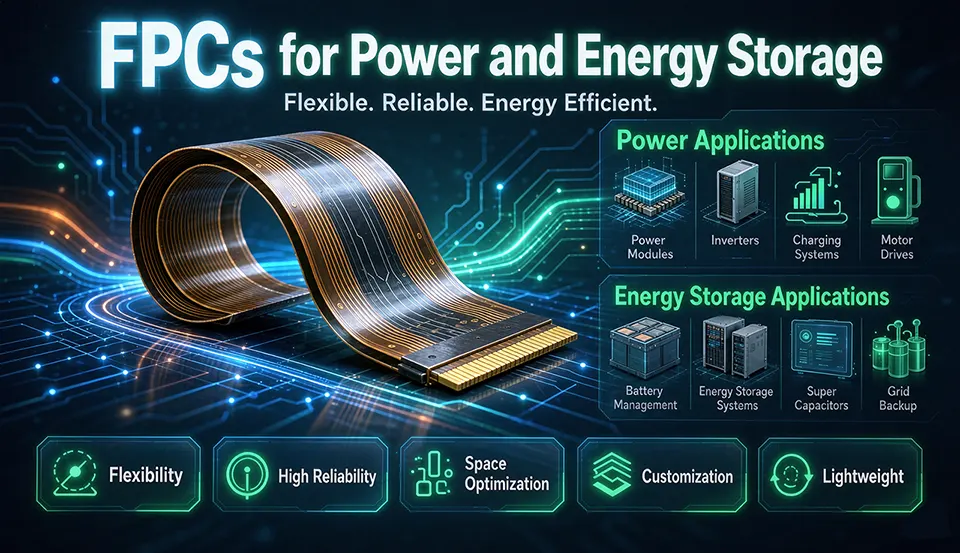
FPCs for Power and Energy Storage Systems: Manufacturing Processes, Technical Requirements, and Industry Evolution

Flexible Printed Circuits (FPCs) used in power systems and energy storage applications play a foundational role in new energy vehicles (NEVs) and battery energy storage systems (ESS). Unlike consumer electronics FPCs, these are not simply interconnect components—they function as critical sensing and signal transmission networks inside battery packs.

They are widely used for voltage sampling, temperature monitoring, and data communication within battery modules, often replacing traditional BMS sampling harnesses or flat flexible cables (FFCs).

Because they operate in high-voltage, high-current, and high-vibration environments—and must also withstand potential thermal runaway scenarios—these FPCs demand extremely high levels of safety, reliability, and durability.

This article outlines their core manufacturing processes, highlights key technical requirements, and explains how they differ fundamentally from standard consumer-grade FPCs.

Special Requirements for Power and Energy Storage FPCs

Before discussing manufacturing processes, it is essential to understand the unique engineering constraints that define material selection and process design.

  • High Voltage and High Current Capability

These FPCs must operate reliably under system voltages up to 800V or higher and support strong current-carrying capacity without overheating or degradation.

  • Exceptional Safety and Reliability

The design must eliminate risks of open circuits and short circuits. High insulation resistance, strong dielectric strength, and excellent arc resistance are mandatory.

  • Thermal and Environmental Resistance

Operating conditions typically range from -40°C to 125°C or higher. The materials must also endure thermal cycling, humidity exposure, and long-term aging without performance drift.

  • Electrolyte Corrosion Resistance

Inside battery packs, electrolyte leakage (e.g., LiPF₆-based systems) may occur. FPC materials must resist chemical corrosion and maintain structural integrity over long service life.

  • Mechanical Balance: Strength vs Flexibility

While certain regions require rigidity for mounting and connector stability, other areas must remain flexible to accommodate vibration, thermal expansion, and cell swelling.

  • Flame Retardancy

Materials must comply with high flame-retardant standards (such as UL94 V-0) to prevent fire propagation in extreme failure conditions.

Core Manufacturing Process Flow

The production of power-grade FPCs follows a highly controlled sequence:

flow chart

Manufacturing Process Flow

Key Process Breakdown

  • Material Selection (Foundation of Reliability)

Engineers determine material selection as the factor that sets the fundamental performance ceiling of the entire product.

In power and energy storage FPCs, designers closely tie material choice to thermal stability, electrical safety, and long-term mechanical endurance.

The base substrate typically uses polyimide (PI) films, often in thicker gauges such as 25μm, 50μm, or above.

The increased thickness is not simply for strength; it plays a key role in improving dimensional stability under thermal cycling and maintaining structural integrity in high-temperature environments.

Engineers generally prefer rolled annealed (RA) copper over electro-deposited (ED) copper for conductive layers.

The reason lies in its superior fatigue resistance under repeated bending and vibration, which is critical in automotive battery environments.

Engineers select copper thickness based on current requirements, typically in the range of 1 oz (35μm) to 2 oz (70μm), particularly for high-current pathways.

Material specialists design coverlay systems and adhesive layers with a strong emphasis on chemical and thermal resilience.

High-performance polyimide-based cover films, combined with adhesives resistant to heat and electrolyte corrosion, ensure stable insulation performance throughout long service life inside battery packs.

In structurally critical regions such as connector interfaces and mounting zones, reinforcement materials are introduced.

These may include FR4, aluminum sheets, stainless steel, or thicker PI layers, each selected according to mechanical load and assembly requirements.

To complete the system, flexible solder mask inks are applied to enhance insulation and provide an additional layer of environmental protection.

  • Circuit Pattern Formation (Core Fabrication)

This stage defines the electrical architecture of the FPC and directly determines its functional integrity.

Operators begin the process by cutting panels and forming vias, using laser drilling or precision mechanical drilling depending on design complexity and required resolution.

Technicians then deposit copper through electroless and electrolytic plating processes to ensure reliable electrical interconnection, particularly within vias.

At this stage, uniformity of deposition and adhesion strength are critical factors influencing long-term reliability.

A photosensitive dry film is subsequently applied to the copper surface and exposed using Laser Direct Imaging (LDI).

This enables high-resolution transfer of circuit patterns with tight dimensional control. After exposure, the development process removes unexposed areas, and chemical etching eliminates excess copper to form precise conductive traces.

After completing patterning, operators strip the protective film and perform 100% Automated Optical Inspection (AOI).

This ensures early detection of defects such as opens, shorts, or pattern deviations before the process advances to subsequent stages.

  • Coverlay Lamination

Technicians precisely align pre-patterned coverlay films with the circuit and laminate them under controlled temperature and pressure conditions in this stage.

Although the process appears straightforward, it is highly sensitive to process parameters.

Temperature uniformity, pressure distribution, and curing time all directly influence adhesion strength, insulation reliability, and long-term resistance to delamination.

  • Surface Finishing

Surface finishing serves two primary functions: protecting exposed copper from oxidation and ensuring stable solderability and electrical contact performance.

Engineers in high-reliability applications most widely adopt ENEPIG (Electroless Nickel Electroless Palladium Immersion Gold) among the available surface finishing options.

It provides a robust diffusion barrier, excellent corrosion resistance, and highly stable solder joint performance.

Manufacturers apply hard gold plating to contact-intensive areas such as connectors because it provides superior wear resistance.

Cost-sensitive applications sometimes use OSP (Organic Solderability Preservative), but engineers generally avoid it in automotive-grade environments due to its limited durability.

  • Reinforcement Lamination

Reinforcement structures are laminated onto designated mechanical zones using controlled high-temperature pressing processes.

This step is critical for ensuring structural rigidity in connector areas and mounting points.

Proper process control ensures precise alignment, strong adhesion, and elimination of voids or air entrapment, which could otherwise compromise mechanical stability.

  • Printing and Marking

Printing processes provide both functional protection and manufacturing traceability. Flexible solder mask ink is applied to non-soldering regions to enhance insulation and environmental resistance.

In addition, component markings such as part numbers, polarity indicators, revision codes, and traceability identifiers are printed onto the surface. These markings play an important role in assembly control and lifecycle traceability within automotive systems.

  • Electrical Testing and Profiling

Before final release, every unit undergoes full electrical verification.

Technicians use flying probe systems or dedicated fixtures to confirm continuity and insulation performance across the entire circuit, ensuring zero defects in electrical functionality.

Manufacturers carry out profiling using laser cutting or die cutting, selecting the method based on production volume and design complexity.

Laser cutting provides high precision with minimal mechanical stress, while die cutting offers efficiency advantages in mass production environments.

After profiling, thorough cleaning is performed to remove any residual particles or conductive debris generated during cutting, preventing potential contamination risks.

  • Final Inspection and Packaging

The final quality control stage combines visual inspection, dimensional verification, and structural assessment.

Quality inspectors carefully review surface defects, contamination, and reinforcement alignment while they measure critical dimensions against strict tolerances.

Packaging engineers design packaging specifically for high-reliability transportation environments.

Manufacturers use anti-static, moisture-resistant, and deformation-resistant materials, and they secure products in individual trays or carriers to prevent mechanical stress during shipping.

Key Differences from Consumer Electronics FPCs

Compared with conventional consumer electronics FPCs, those used in power and energy storage systems operate in a fundamentally different engineering regime.

The most immediate distinction lies in electrical demand: automotive and ESS applications require significantly higher voltage and current handling capability, often under sustained and highly dynamic load conditions.

This directly drives a second major difference—much stricter safety and insulation requirements.

In battery environments, any risk of short circuit, insulation breakdown, or arc propagation is unacceptable, which leads to far more conservative design margins and tighter material control.

Material selection also shifts accordingly. Power FPCs typically rely on thicker copper foils and more robust substrate systems to ensure stable current-carrying capacity and mechanical integrity under vibration and thermal stress.

At the same time, resistance to corrosion and high-temperature aging becomes a core requirement, given long-term exposure to chemically active and thermally aggressive environments inside battery packs.

Another key difference is the level of validation required. Compared to consumer electronics, these products undergo significantly more extensive reliability testing, including electrical, environmental, and lifecycle verification.

Engineers place far greater emphasis on mechanical reinforcement and structural integration. They integrate FPCs into the mechanical architecture instead of treating them as standalone interconnects.

Technology and Industry Development Trends

  • Integration and Functionalization

The role of FPCs is shifting from passive signal carriers to integrated functional modules within battery systems.

Design teams increasingly incorporate embedded sensing and protection capabilities into these systems.

These capabilities include integrated NTC/PTC temperature sensors, micro-fuses, and on-board voltage and current sensing circuits.

In more advanced architectures, chip-level integration is also emerging, where FPCs incorporate ICs or microcontrollers (FPC-SiP concepts) to enable localized data processing.

This reduces reliance on centralized BMS computation and improves system responsiveness.

At the same time, structural integration is accelerating.

Engineers now co-design FPCs with busbars, insulation films, and thermal management materials, rather than treating them as isolated layers.

This trend significantly reduces interconnect complexity while improving overall system compactness and assembly efficiency.

  • Material and Process Innovation

The push toward higher-voltage platforms, particularly 800V architectures and fast-charging systems, is accelerating material and process upgrades across the industry.

Substrates are evolving toward higher thermal stability, with polymer systems capable of withstanding temperatures above 150°C becoming more common.

Engineers are improving adhesive systems to enhance long-term resistance to electrolyte corrosion and thermal aging.

Manufacturers are adopting thicker copper foils and optimizing lamination processes to support increasingly high current loads—often exceeding 300A in localized pathways—while preserving flexibility and fatigue resistance.

Design teams are introducing thermally conductive FPC structures to improve heat dissipation for sensitive components such as BMS electronics, making thermal management an emerging focus area.

In parallel, circuit design is moving toward finer geometries, with line widths and spacing approaching 50μm-class precision.

On the surface treatment side, ENEPIG has effectively become the mainstream choice for high-reliability applications due to its balance of corrosion resistance and solderability, and it continues to evolve toward more uniform and controlled deposition characteristics.

  • Intelligence and Digitalization

A clear trend is the transformation of FPCs into intelligent data nodes within battery systems.

Beyond simple signal transmission, they are increasingly responsible for local data acquisition, filtering, and preliminary processing.

With integrated sensing elements, FPCs can support multi-dimensional battery health evaluation, including traditional voltage and temperature monitoring as well as emerging indicators such as cell swelling and internal stress changes derived from strain sensing technologies.

In certain system architectures, exploration is also underway into wireless communication methods such as BLE, particularly for modular or replaceable battery designs where reducing physical wiring complexity offers clear system-level advantages.

  • Standardization and Modular Design

As system complexity increases, the industry is moving toward greater standardization and modularization.

Connector interfaces, signal definitions, and communication protocols are gradually being unified, enabling cross-platform compatibility across different vehicle and battery manufacturers.

Designers are developing FPCs as modular functional blocks. These functional blocks include sensing, balancing, and communication units and can be combined in different configurations depending on application requirements.

This “building-block” approach significantly shortens development cycles while improving design scalability and manufacturing efficiency.

  • Cost Optimization and Green Manufacturing

Despite increasing complexity, cost efficiency remains a central driver of innovation. Design optimization stands as one major direction, with simulation-driven approaches reducing material usage while maintaining performance and reliability.

Manufacturing is also becoming increasingly automated, with greater use of high-precision laser cutting, AOI inspection, and automated assembly processes to improve yield and consistency.

At the supply chain level, localization of key materials such as PI films, copper foils, and specialized adhesives is accelerating, reducing dependency on imported high-performance inputs.

Finally, environmental considerations are becoming integral to design and production.

Compliance with RoHS and halogen-free standards is now baseline, while the industry is also exploring recyclable materials and more sustainable manufacturing pathways to align with long-term green energy goals.

Conclusion

The production of FPCs for power and energy storage applications essentially involves the enhancement and upgrading of traditional FPC manufacturing processes under ultra-high reliability requirements.

Its core competitiveness lies not only in precise pattern fabrication capabilities but also in:

1. A deep understanding of and ability to apply specialty materials (such as corrosion-resistant adhesives and RA copper).

2. An extremely rigorous and stable process control system (CPK values for each stage).

3. Comprehensive and stringent testing and validation capabilities (electrical, environmental, lifespan, and safety).

4. Complete traceability (from raw material batches to the final product).

In the future, FPCs for power and energy storage applications will evolve along two main trajectories: “integration of structure and function” and “hardware-software synergy.” They will transition from etched FPCs to die-cut FDCs.

They will evolve from passive connection components into critical battery pack subsystems capable of active sensing, intelligent processing, and reliable execution.

Vision for the Ultimate Form:

A “smart battery skin” may emerge as a highly integrated FPC solution. This structure covers the surface of a battery cell or module and integrates all sensors, management chips, and communication units.

It monitors the battery’s “body temperature, blood pressure, and pulse” in real time and works seamlessly with the battery pack’s “brain” (the main BMS), becoming the cornerstone for ensuring battery safety, enhancing performance, and extending lifespan.

This requires the deep integration of materials science, electrical engineering, semiconductor technology, and battery technology.

This high-end FPC market segment faces significant technical barriers and lengthy certification cycles, yet delivers even greater value.

With the development of the new energy vehicle and energy storage industries, its manufacturing processes continue to evolve toward higher integration (such as SIP-FPCs with embedded chips), higher voltage ratings, and stronger thermal management capabilities.