
FCCL vs. Rigid Copper Clad Laminate: Key Differences & How to Choose
FCCL vs. Rigid Copper Clad Laminate is decided by one question: must the circuit bend? FCCL bonds copper foil to a flexible film such as polyimide, PET, or PEN. Rigid copper clad laminate is the FR-4 glass-epoxy sheet behind most flat PCBs. So FCCL flexes and folds, while rigid CCL stays flat.
This guide compares both materials layer by layer. It also gives a practical FCCL substrate selection path you can apply to your next design.
What Is FCCL?
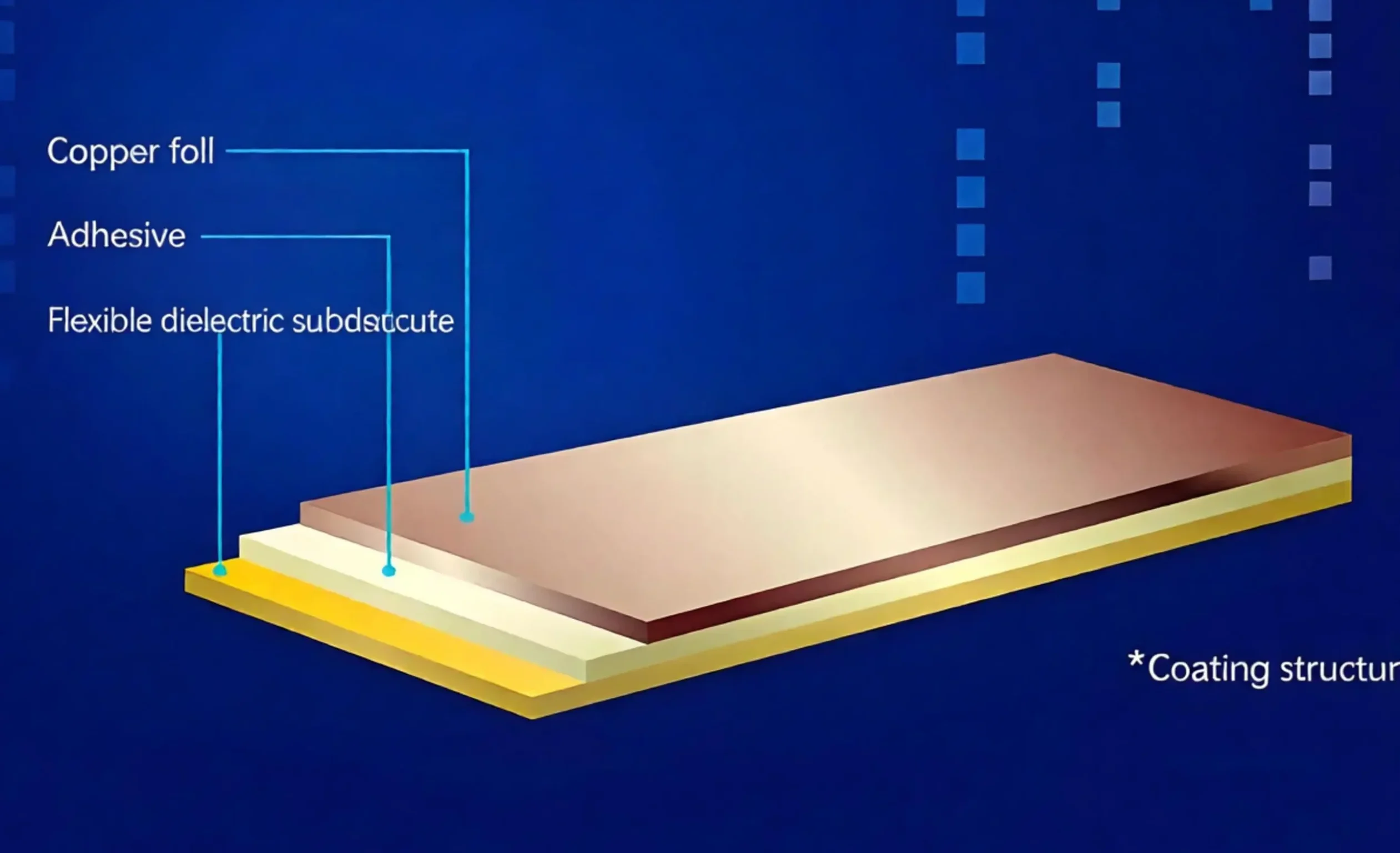
FCCL coating structure
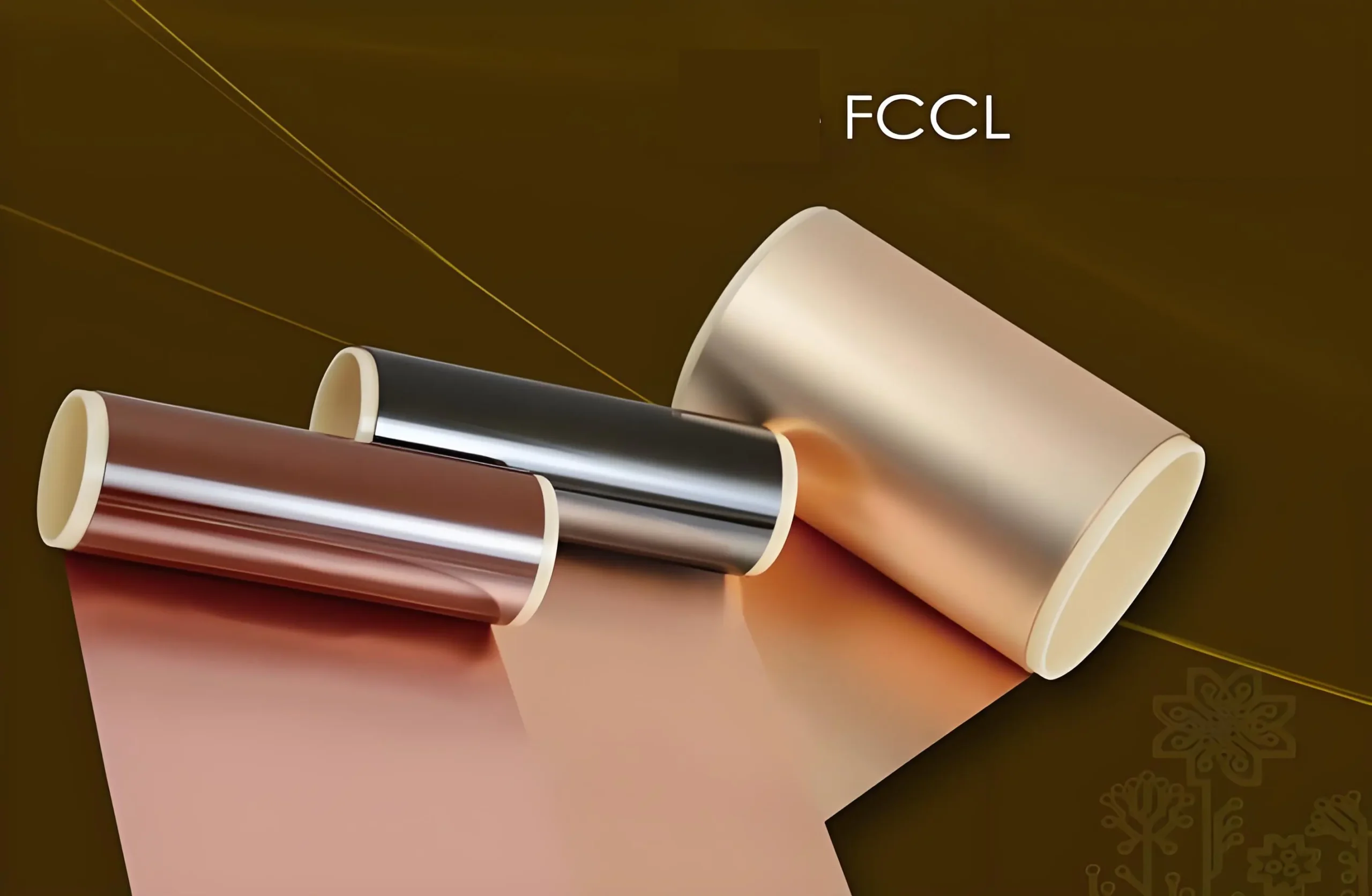
FCCL is the base material for flexible printed circuits (FPCs). It has three layers: copper foil, a flexible dielectric film, and the bond between them. The copper is rolled annealed (RA) or electro-deposited (ED). The film is polyimide, PET, or PEN.
In an adhesiveless FCCL, copper bonds directly to polyimide. This raises thermal resistance, cuts thickness, and improves dimensional stability. Therefore, adhesiveless grades dominate high-reliability FPC designs. See Adhesive-Free FCCL Substrates for the trade-offs.
IPC-4204 classifies FCCL by base film, copper type, and adhesive characteristics. Typical film thickness runs 12–50 µm, and copper runs 9–70 µm. For a wider material view, read the Flexible Copper-Clad Laminate guide.
The main advantage is mechanical flexibility. A good FCCL withstands thousands of bend cycles without conductor cracking, especially with RA copper.
What Is Rigid Copper Clad Laminate?
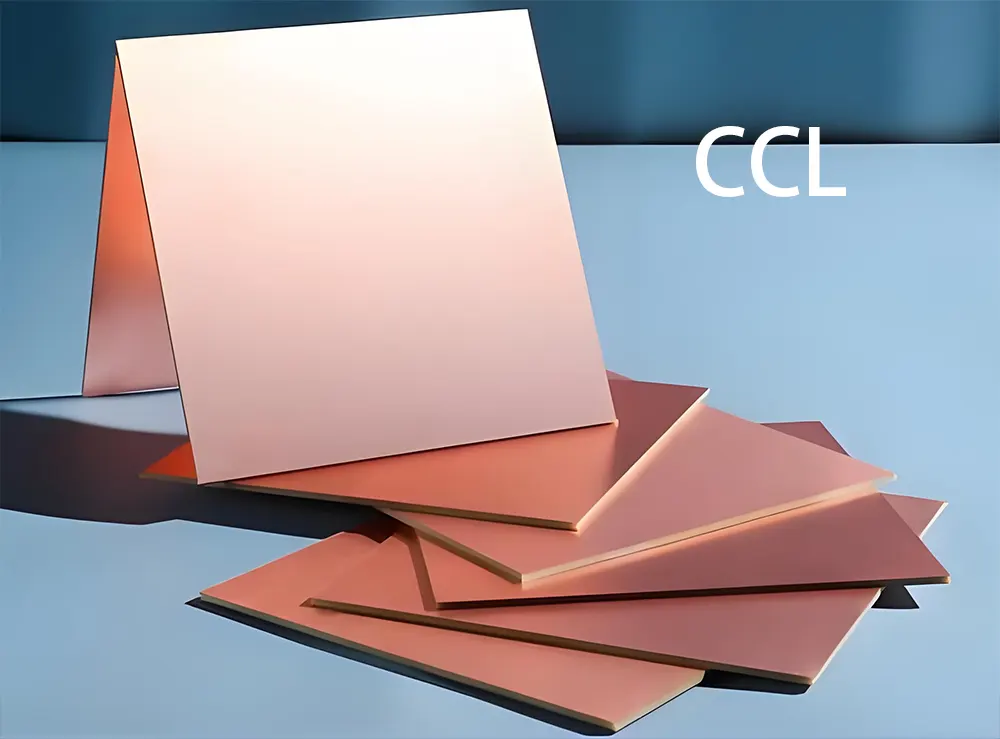
CCL
Rigid copper clad laminate is the laminate used in rigid printed circuit boards. The most common type is FR-4. It uses woven glass fiber cloth impregnated with epoxy resin. Copper foil covers one or both sides.
FR-4 offers high mechanical stability, a glass-transition temperature (Tg) of 130–180°C, and excellent electrical insulation. However, it cannot bend. Stress beyond its flexural limit cracks the board.
FCCL vs. Rigid Copper Clad Laminate: Key Differences
The table below sums up the main engineering differences. Both materials use copper as the conductive layer. The substrate is where they split.
| Property | FCCL | Rigid CCL (FR-4) |
|---|---|---|
| Base material | Polyimide, PET, PEN film | Woven fiberglass + epoxy resin |
| Copper foil | RA foil (best flex endurance) or ED foil | ED foil (standard) |
| Substrate thickness | 12–100 µm | 0.1–3.2 mm |
| Flexibility | Bent, folded, and dynamically flexed | Rigid; no flexing allowed |
| Bend radius | Down to 0.5 mm or less, by stack-up | Not specified |
| Operating temperature | Polyimide up to 200°C; PET up to 105°C | FR-4 up to 130–180°C |
| Cost per unit area | Higher | Lower |
| Typical layer count | 1–4 layers | 2–20+ layers |
Copper Foil Choice
Copper foil type drives bend life. RA copper resists cracking better than ED copper under repeated flexing. Therefore, dynamic flex designs usually specify RA foil. Static rigid boards use standard ED foil.
Thickness and Heat
FCCL films are far thinner than FR-4 cores. That thin stack helps bending, but it limits stiffness. Polyimide FCCL handles up to 200°C. PET stops near 105°C. FR-4 runs 130–180°C.
In short, the FCCL vs rigid copper clad laminate gap is structural, not cosmetic. One material bends by design; the other holds shape by design.
Applications of FCCL and Rigid CCL
FCCL serves flexible circuits, including single-sided, double-sided, and multilayer flex. It also supports flex assemblies. Typical markets include mobile phones, consumer electronics, medical devices, industrial automation, and automotive.
Rigid CCL serves conventional rigid boards. These boards stay flat inside the device and often carry many layers. For mixed designs, Rigid-Flex PCB combines both material types. Read more in Rigid-Flex PCB Technology.
FCCL Substrate Selection: Properties That Decide
FCCL substrate selection starts with mechanical duty, not price. First define how the circuit moves. Then match the film, copper, and adhesive system to that duty.
Match the Film to Heat and Flex
Polyimide is the default for high heat and dynamic flex. PET suits lower-temperature, cost-sensitive designs. PEN is another film option in the FCCL family. Always confirm the film grade with your supplier.
Ask for Measurable Data
Request Dk/Df, CTE, moisture absorption, peel strength, and bend-cycle data. Also confirm copper type (RA or ED) and the adhesive system. For plating-related quality, see Carbon-Coated Film Evaluation.
Decide Adhesive vs Adhesiveless
Adhesiveless FCCL is thinner and more stable. It also handles heat better. Adhesive-based FCCL can still fit less demanding flex designs.
How to Choose the Right Copper Clad Laminate
Keep the FCCL vs rigid copper clad laminate comparison practical. Use this sequence.
Step-by-Step Decision Path
1. Does the circuit move? If it stays flat, start with rigid CCL. If it bends or folds, start with FCCL.
2. What kind of bend? Static bend and dynamic cycling need different copper and film choices.
3. How tight is the bend? Set the bend radius before you pick thickness.
4. What heat does it see? Check operating temperature and assembly temperature.
5. How many layers? Flex circuits typically use 1–4 layers. Rigid boards often use 2–20+ layers.
6. Confirm data and cost. Compare total cost, not only price per unit area.
When Rigid-Flex Is the Better Middle Option
Sometimes one board must hold stiff SMT areas and moving sections. Then rigid-flex is the better middle option. It uses rigid CCL for stiff zones and FCCL for flex zones. This can remove connectors and cables in compact products. See Rigid-Flex PCB and Custom Flex PCB for the build options.
Selection Checklist
- Does the circuit bend, fold, or stay flat?
- Is the flex static or dynamic?
- What is the minimum bend radius?
- What is the maximum operating temperature?
- Which copper foil type is specified?
- Is the FCCL adhesive-based or adhesiveless?
- How many layers are required?
- What data does the supplier provide?
Design, Processing, and Cost Notes
Failure Modes to Design Out
Most flex failures start at the bend. A bend radius that is too tight shortens flex life. Dynamic flex with the wrong copper foil also cracks conductors. In addition, coverlay design affects reliability. Check coverlay bonding strength when the stack includes coverlay.
Assembly and Processing
Confirm that the laminate survives your assembly temperature. Polyimide FCCL gives more heat margin than PET. Also check dimensional stability before panelization. Flex panels and rigid panels need different SMT handling.
Total Cost View
FCCL costs more per unit area. FR-4 costs less because production is mature and high volume. However, flex can remove connectors, cables, and assembly steps. It can also save space. Therefore, judge total cost, not material price alone.
Common Misconceptions
- “FCCL can replace every rigid CCL.” No. FCCL suits bending circuits; rigid CCL suits flat, stiff boards.
- “Thinner is always better.” No. Thin film helps bending but can reduce stiffness.
- “All FCCL is the same.” No. Film, copper foil, and adhesive system change performance.
FAQ
Is FCCL more expensive than rigid copper clad laminate?
Yes, per unit area. FCCL uses thin films and special processing, so it costs more. FR-4 is cheaper because production is mature and high volume. However, flex can cut connectors, cables, and assembly steps. Compare total cost, not price alone. For process questions, see the PCB Manufacturing FAQ.
Can FCCL and rigid CCL be mixed in one design?
Yes, through rigid-flex construction. Rigid CCL forms stiff areas for components, while FCCL forms flexing areas. They cannot be directly substituted in the same area, but they can coexist in one board. This removes connectors and cables in compact products.
How many bend cycles can FCCL withstand?
Bend life depends on design and materials. With RA copper and a proper bend radius, FCCL can survive thousands to hundreds of thousands of cycles. Dynamic flex applications require testing to confirm. Static flex has less stringent requirements.
Does FCCL require different processing than rigid CCL?
Yes. FCCL is thinner and more flexible, so handling, lamination, and assembly differ. Flex circuits often need coverlay instead of solder mask, and panelization and SMT support are different. Work with a fabricator experienced in flex.
What should I check first in FCCL substrate selection?
Start with movement and heat. Confirm static or dynamic flex, then set the bend radius. Next, pick the film. Polyimide covers up to 200°C, while PET covers up to 105°C. Finally, confirm copper foil type and the adhesive system.
Related Posts
- Flexible Copper-Clad Laminate Guide — Related article
- Carbon-Coated Film Evaluation for Reliable FCCL Copper Plating — Related article
- Adhesive-Free FCCL Substrates vs Adhesive-Based FCCL — Related article
- Coverlay Bonding Strength Optimization in Rigid-Flex PCB — Related article
- Dual-Laser Etching and Cleaning for FCCL Blind Vias — Related article
- Flexible PCBs: Structure, Materials, and Selection Guide— Related article