
Explore the Cutting – Edge World of PCB Technology!
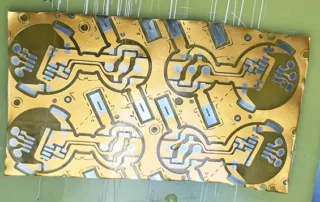
PTFE Blind Via Processing for High-Frequency FPC: Process Optimization and Insertion Los
Industry Background and Technology Trends With the rapid advancement of artificial intelligence, 5G communications, and IoT technologies, electronic devices are rapidly evolving toward higher frequencies, faster speeds, miniaturization, and integration. Against this backdrop, high-frequency flexible printed circuit boards (FPCs), as critical interconnect components, face increasingly stringent performance requirements. Signal transmission integrity and low-loss characteristics have become key factors determining[...]

Optimizing Blind Slot Multilayer Flexible PCB Manufacturing: A New Laser-Controlled Fabrication Method
As an interconnection between electronic components, multilayer flexible printed circuit boards (FPCBs) meet the circuit connection needs of various electrical and electronic products. They align with the industry trend toward lighter, thinner, shorter, smaller, higher-performance, and high-density electronic devices. Electronic products become increasingly miniaturized and diversified. Traditional planar circuit boards face significant constraints in space utilization and safety. Fail[...]

Flexible Tactile Sensor Design Using FPCB Processing for Robotic and Industrial Applications
Tactile sensors can obtain relevant characteristics of both the sensor and the contacted object's surface through physical contact, such as temperature, pressure, hardness, and material properties. With the advancement of robotic bionics, the application scope of these “artificial skin”-like tactile sensors continues to expand, playing an increasingly vital role in robotic bionics, medical devices, and various industrial equipment. Scholars[...]
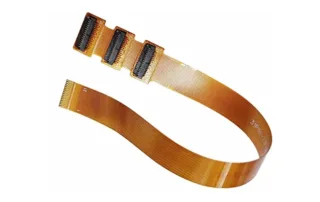
What is the Class-Wire Harness Flexible PCB Manufacturing Technology?
In recent years, the rapid development of high-end industries such as intelligent connected vehicles and low-altitude aircraft has driven continuous innovation in flexible printed circuit boards (FPCBs). In traditional automotive applications, certain wiring and distribution functions rely on wire harnesses, as illustrated in Figure 1. Conventional wire harnesses feature a structure where copper wires are encased in plastic insulation[...]
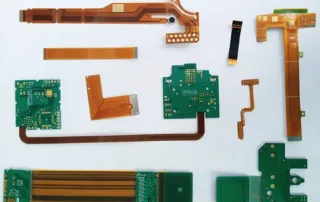
PI Protective Film Process for Rigid-Flex PCBs: Reducing Flexible-Area Cosmetic Defects
The PI protective film process for rigid-flex PCBs applies a polyimide (PI) protective film onto the cover film surface of the flexible area before or during lamination. Its primary purpose is to shield the flexible panel from prepreg (PP) powder, resin overflow, pitting, compression cracking, and contamination—defects that commonly occur during rigid-flex lamination and lead to high scrap rates.[...]
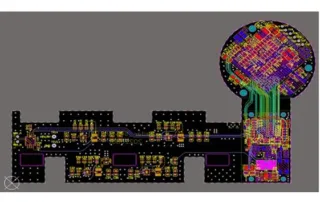

Flexible Electronics–Enabled RF Signal Processing Circuits for Miniaturized Missile Systems
With the widespread operational deployment of unmanned platforms, miniaturized, low-cost, and mass-produced munitions will become an inevitable trend in future weapons development. Therefore, designers must minimize the volume ratio of onboard electronic equipment, controlling it within 15% to 20% to reserve more space for warheads and propulsion systems. Miniaturization Challenges in Next-Generation Munitions However, traditional rigid circuit system structural[...]