
RA Copper vs ED Copper: Which Foil Fits Flexible PCB?
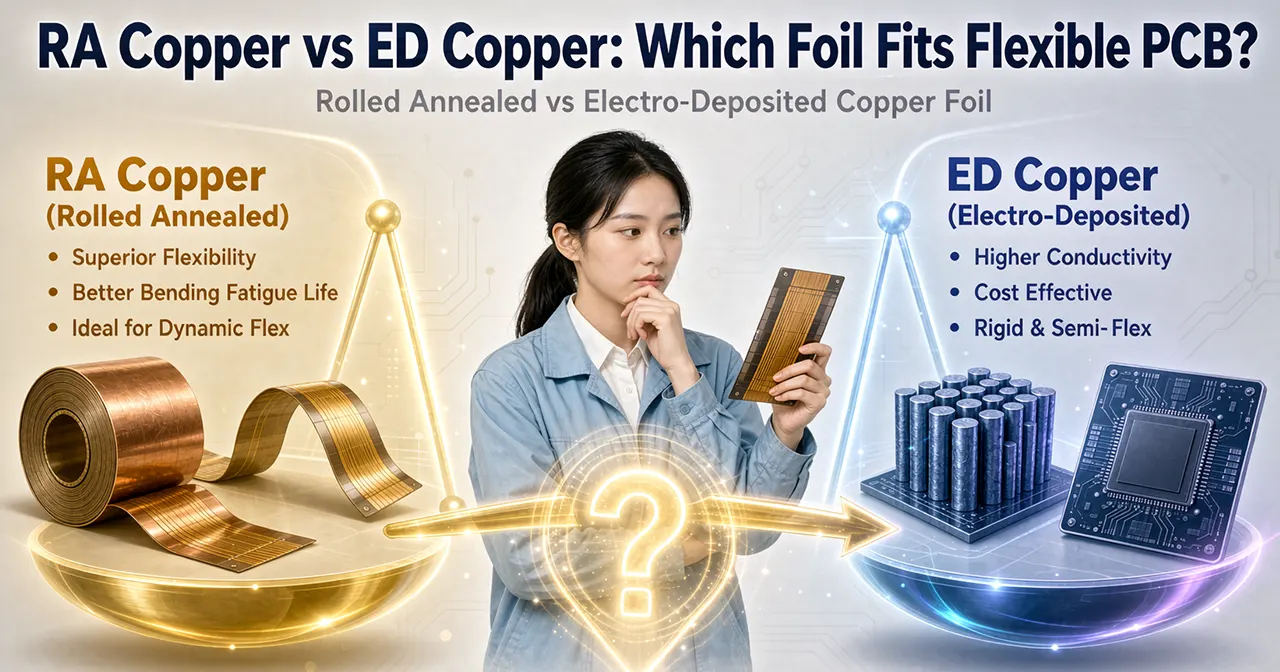
RA Copper vs. ED Copper comes down to grain direction and the bend duty of the board. Rolled annealed (RA) copper has grains stretched horizontally, so it survives repeated bending. Electrodeposited (ED) copper grows columnar grains, which crack sooner under dynamic flex but cost less. The trade-off is clear: ED has a rougher surface for good adhesion and higher conductivity, but it is more brittle; RA offers better ductility and dynamic bend life, but costs more and is slightly lower in conductivity. For FPC copper foil selection, choose RA for dynamic flex and ED for static or single-bend boards, and do not dismiss ED where fine-line etching and tight spacing matter.
What Are RA Copper and ED Copper?
Both foils are copper. However, they are produced in different ways. That difference shapes grain structure, bend life, surface roughness, and price.
Rolled Annealed (RA) Copper
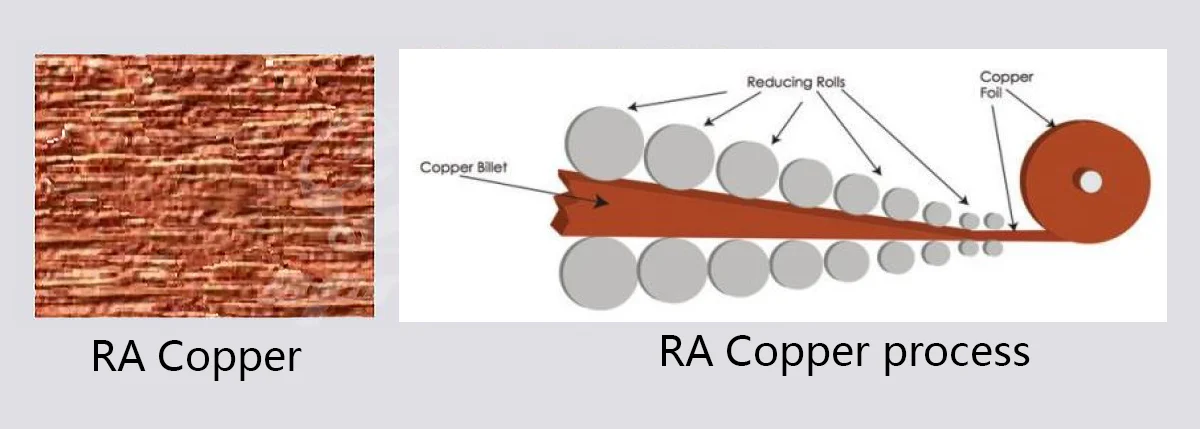
RA Copper structure and manufacturing process
RA copper begins as a cast ingot. The ingot is rolled down in steps, then annealed to soften it. Therefore, the grains stretch along the rolling direction. This horizontal grain flow lets the foil bend without cracking too early.
Electrodeposited (ED) Copper
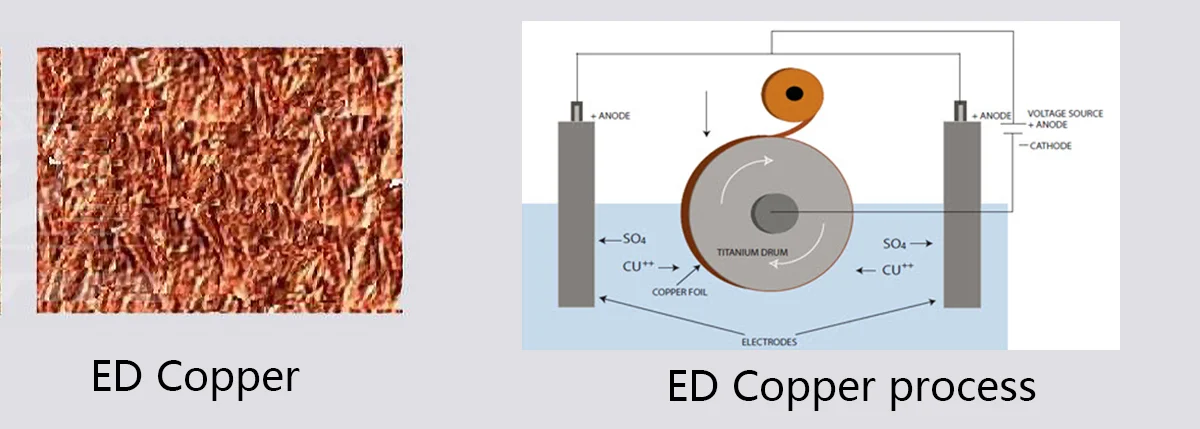
EDCopper structure and manufacturing process
ED copper grows on a rotating drum inside a plating bath. Its grains grow upright, so they stand vertically. As a result, the foil costs less to produce, yet the columnar grains limit repeated bending.
Rolled Copper vs Electrodeposited Copper: Key Differences
The table below sums up the main trade-offs when you compare rolled copper vs electrodeposited copper for FPC work. Values are typical ranges; confirm them with your foil supplier and test coupon because surface treatment, gauge, and lamination change the result.
| Point | RA (rolled) copper | ED (electrolytic) copper |
|---|---|---|
| Grain structure | Elongated, horizontal grain flow | Columnar, vertical grains |
| Flexibility and bend life | High ductility; elongation often 10–30%; can reach 10^5–10^6 flex cycles at a suitable radius | Lower ductility; elongation often 2–10%; typically 10^2–10^4 cycles in comparable tests |
| Adhesion and surface roughness | Smoother; Rz often 0.5–2 µm; adhesion depends on treatment and lamination | Rougher standard grade; Rz often 2–5 µm; mechanical anchoring improves adhesion |
| Conductivity | About 98–100% IACS, supplier-dependent; slightly lower than high-purity ED | About 100–102% IACS for high-purity ED; low-profile grades can be close to RA |
| Cost | Higher; RA premium often 20–100% over ED at the same gauge | Lower; broad stock and lower unit cost |
| Typical thickness | 9–70 µm; common FPC gauges 12, 18, 35 µm | 9–105 µm; common FPC gauges 12, 18, 35 µm |
| Typical applications | Dynamic flex, hinges, sliding parts, repeated-motion medical or automotive flex | Static flex, single-bend rigid-flex, fine-line etching, tight trace spacing, cost-driven designs |
Bend direction matters too. For instance, RA foil usually performs better when the bend line crosses the rolling direction. Also, the foil sits on flexible copper clad laminate (FCCL). There, lamination heat and adhesion change real results. For stack-up basics, review FCCL vs. Rigid Copper Clad Laminate.
How Grain Structure Affects Flex Life
Grain boundaries are the weak points in any foil. In ED copper, those boundaries run vertically. Therefore, a bend pulls them apart sooner. In RA copper, the boundaries run along the surface, so strain spreads across more grains.
Next, think about bend radius. A tight radius concentrates stress in a small area. A wider radius spreads the load. Consequently, designers often pair a tight radius with thinner RA foil.
Quantify the risk before you choose. A copper foil data sheet should give tensile strength, elongation, and surface roughness. RA foil commonly shows higher elongation, which is the ability to stretch before breaking. ED foil often shows higher tensile strength but less elongation. In a flex test, record the mandrel radius, stroke, cycle rate, and whether the foil is in tension or compression. IPC-4562 covers metal foil requirements, IPC-6013 covers flexible board performance, and IPC-TM-650 methods are commonly used for flex endurance and adhesion checks. Use those methods to compare suppliers on the same test coupon.
FPC Copper Foil Selection: A Practical Checklist
FPC copper foil selection follows a few simple checks. Work through them before you release the stack-up.
Step 1: Define the Bend Type
Ask how the board moves. Static flex, install-and-forget, tolerates ED copper. Dynamic flex, with repeated motion, favours RA copper. Hinge and sliding parts sit in the dynamic group, and rigid-flex builds often mix both motion types.
Step 2: Check Fine-Line Etching and Spacing
Fine-line etching and tight spacing change the decision. ED copper is not the weak choice here. Low-profile ED grades are widely available in thin gauges, etch uniformly, and support close trace spacing and controlled impedance. Standard ED has a rougher surface, so specify a low-profile ED when you need fine lines. RA is smoother, but its cost and supply can be harder to justify when the bend zone is static.
Step 3: Check Thickness and Adhesion
Thinner foil bends more easily, but it carries less current. Also, confirm the foil adheres well to the FCCL after lamination. Plating and film choice influence that bond, as the Carbon-Coated Film Evaluation shows. Match the foil surface treatment to the coverlay adhesive and the plating process, not just to the foil name.
Step 4: Compare Cost and Supply
ED copper costs less per unit area. However, a cracked trace costs far more than the foil itself. Therefore, match the foil to the real movement in the product. Also check RA premium, minimum order quantity, and lead time before you lock the schedule.
Step 5: Confirm the Test Plan
Agree on a bend test coupon, radius, and cycle count before production. Use the same test for the foil and the finished flex. If the design has mixed motion, test the worst-case dynamic zone.
Cost, Thickness, and Availability
Both foils come in the common gauges used for flexible circuits. RA copper carries a higher price because rolling and annealing add process steps. In addition, lead times can be longer for special thicknesses. As a planning rule, expect an RA premium over ED at the same gauge, higher minimum order quantities for non-stock RA gauges, and longer lead times for special widths. ED copper is widely stocked, so it is often the default for simple single-sided flex. If your product serves medical, automotive, or industrial use, see High-Reliability Flexible Circuits for High-End Applications for the wider reliability view.
Hybrid Stack-Ups, Surface Treatment, and Failure Modes
You do not always need one foil for the whole board. A hybrid stack-up can use RA only in the dynamic bend zone and ED in static or stiffened areas. This is common in rigid-flex designs, where the flex tail moves and the rigid section does not. The compromise lowers cost while keeping bend life where it matters. Define the boundary clearly, and do not put a solder mask or coverlay transition in the highest-strain area.
Surface treatment and lamination decide much of the real reliability. RA and ED foils both need a treatment that bonds to the FCCL, and the coverlay adhesive must flow and cure without voids. For fine lines, a low-profile ED foil can reduce undercut and over-etching risk. For dynamic flex, RA foil with a controlled surface roughness gives a more forgiving bend zone. Common failure modes are copper cracking at grain boundaries, delamination between foil and coverlay, over-etched thin traces, and handling cracks at the panel edge. Build a first-article test that looks for all four.
Decision Flow and Selection Checklist
Use this flow to answer the title question for your own board:
- If the flex zone moves many times, use RA copper, especially for a tight bend radius, hinge, or sliding part.
- If the board bends once during assembly, use ED copper unless the trace spacing or current demands a special foil.
- If the design needs fine-line etching and tight spacing, compare low-profile ED first, then use RA only where dynamic bend life is mandatory.
- If the board mixes static and dynamic zones, use a hybrid stack-up with RA in the moving zone.
- If cost, MOQ, or lead time controls the schedule, confirm RA supply before release and keep ED as the volume default.
- If the product is high-reliability, require a bend test to IPC-6013 and foil data to IPC-4562, then compare suppliers on the same coupon.
Common pitfalls: choosing ED for a dynamic hinge because it is cheaper; choosing RA everywhere when only a small zone moves; assuming thinner foil always gives better flex life; ignoring bend direction against the RA rolling direction; and skipping the coverlay adhesion check after lamination.
FAQ
Is RA copper always better than ED copper for a flexible PCB?
No. RA copper wins on repeated bending, because its grains run horizontally and spread the strain. ED copper suits static or single-bend boards and costs less per unit area. Match the foil to the real movement of the product, not to a general rule.
When must I choose RA copper?
Choose RA copper for dynamic flex designs, tight bend radii, and hinge or sliding parts that move many times. It is also the safer choice when a crack would stop a medical, automotive, or industrial product. Check adhesion to the FCCL after lamination, and order special gauges early because lead times can run longer than ED stock items.
Can I mix RA and ED copper in one flexible PCB?
Yes. A hybrid stack-up can place RA in the dynamic bend zone and ED in static, stiffened, or cost-sensitive areas. Keep the foil transition away from the highest-strain region, and test the finished flex rather than the foil alone.
Does thinner foil always give better flex life?
Thinner foil bends more easily, yet it carries less current. Therefore, pick the thinnest foil that still meets current and adhesion needs. For a tight radius, thinner RA copper is the usual pairing in flex designs.
Which thickness should I start with for FPC copper foil?
Start with 12, 18, or 35 µm, then check current capacity, impedance, and bend radius. Thinner RA foil helps a tight dynamic bend; thicker ED foil may be fine for a static board with higher current.
Can ED copper be used with adhesive-less FCCL?
Yes, when the foil surface treatment matches the adhesive-less bonding process. Low-profile ED grades are often used for fine lines. Confirm peel strength and thermal stress with the laminate supplier, and do not assume the foil name alone controls adhesion.
Is ED copper better for high-frequency flex?
Not automatically. Low-profile ED can be a good high-frequency choice because smooth copper reduces conductor loss, but dielectric loss, stack-up, and impedance control matter as much as foil type. Compare roughness and conductivity data for the actual grades.
Which foil fits my flexible PCB?
If the flex zone moves repeatedly, choose RA copper. If the board is static or single-bend and needs fine-line etching or lower cost, choose ED copper. If both motion types exist, use a hybrid stack-up and test the worst-case bend zone.
Gekun has manufactured flexible circuits since 2014 and can advise on foil choice for your stack-up.
Related Posts
- Carbon-Coated Film Evaluation for Reliable FCCL Copper Plating — Related article
- Enhancing FPC Insulation Performance — Related article
- FCCL vs. Rigid Copper Clad Laminate: Key Differences — Related article
- FPCB Differential Impedance Optimization with Mesh Copper — Related article
- How to Choose the Right Flex Material for Your PCB— Related article
- Flexible PCB Failure Modes & Prevention Guide — Related article