Types and Characteristics of Flexible Copper-Clad Laminates
Copper-clad laminates (CCL) used in the manufacture of printed circuit boards (PCBs) can be divided into two major categories: copper-clad laminates (CCL) and flexible copper-clad laminates (FCCL).
Most flexible copper-clad laminates consist of a flexible insulating base film and a metal layer. High flexibility is the most prominent product feature of flexible copper-clad laminates;
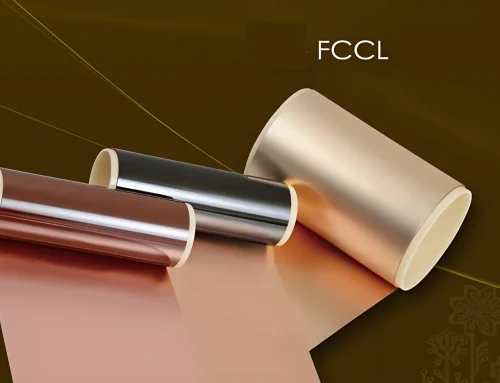
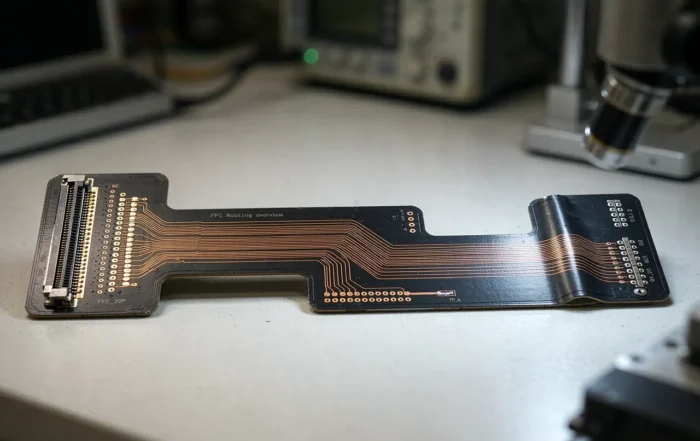
Therefore, they are also known as flexible copper-clad laminates or soft copper-clad laminates (commonly referred to in Taiwan as “soft copper-clad laminates” or “soft copper-clad substrates”). A typical FCCL product is shown in Figure 1.
Fig 1: Appearance of typical FCCL products
FCCL can be manufactured using a variety of processes to bond metal foil to an insulating base film. Examples include resin adhesive coating and direct deposition methods (such as electroplating, sputtering, and electroless plating).
Types of Flexible Copper Clad Laminates
Traditional FCCL products are primarily composed of three distinct layers with different materials and functions: copper foil, a base film, and an adhesive.
For this reason, they are often referred to as “three-layer flexible copper-clad laminates” (abbreviated as “3L-FCCL”). Over the past decade, a new product structure of flexible copper-clad laminates has seen rapid growth in applications.
This is the two-layer flexible copper-clad laminate (abbreviated as “2L-FCCL”).
The structural characteristic that distinguishes it from the three-layer flexible copper-clad laminate is the absence of an adhesive layer with a composition different from that of the base film; consequently, it is also referred to as an adhesive-free flexible copper-clad laminate.
Market Trends and Applications of 2L-FCCL
Driven by the miniaturization of electronic products and the rapid development of LCD-based electronic devices, the market for COF (Chip on Flex) applications has expanded rapidly since the second half of 2003.
As a key component of COF, the COF flexible substrate is currently experiencing rapid growth in both technology and market demand.
In LCD driver ICs, it serves to mount the IC chip, provide circuit interconnections, and offer insulating support.
Its three prominent features are high-density fine-line circuits, high precision in lead placement, and the use of two-layer flexible copper-clad laminate (2L-FCCL).
Compared to three-layer flexible copper-clad laminate (3L-FCCL), 2L-FCCL offers advantages in numerous performance aspects.
Since it does not contain epoxy or acrylic adhesive layers, it exhibits excellent heat resistance, dimensional stability, and chemical resistance, leading to rapid development.
Applications and Market Trends of 2L-FCCL
The application scopes of 2L-FCCL and 3L-FCCL differ. Currently, 3L-FCCL is used in mass-market flexible circuit products, while 2L-FCCL is used in the manufacture of higher-end flexible circuits, such as rigid-flex boards and COF packages.
In terms of the FCCL market structure, 2L-FCCL accounts for approximately 15–20%, while 3L-FCCL accounts for about 80–85%.
However, the current price of 2L-FCCL is 1.5–2 times that of 3L-FCCL, though some manufacturers can offer it at a comparable or lower price.
It is estimated that the global annual growth rate for 2L-FCCL will remain above 40% in the future, far exceeding the 25% growth rate of 3L-FCCL.
Based on this growth rate, it is projected that within five years, the share of 2L-FCCL in the overall FCCL market will rise from 15% to 40–50%, gradually narrowing the gap with 3L-FCCL until a stable and balanced market is achieved.
As COF packaging gradually replaces TAB (Tape Automated Bonding) as the mainstream packaging method, 2L-FCCL adhesive-free flexible substrate materials will become increasingly favored by flexible circuit manufacturers.
Comparison Between 2L-FCCL and 3L-FCCL
| Item | Three-Layer Flexible Copper Clad Laminate (3L-FCCL, Adhesive-Based) | Two-Layer Flexible Copper Clad Laminate (2L-FCCL, Adhesive-Free) |
|---|---|---|
| Insulating Base Film Thickness | 30–150 μm (including adhesive layer) | 12.5–125 μm |
| Heat Resistance | Low | High |
| Dimensional Stability | Poor | Excellent |
| Flexibility (Bending Resistance) | Good | Varies depending on the manufacturing method |
| Ease of PCB Processing | Easy | More difficult |
| Application History | Long | Short |
| Manufacturing Cost | Low | Currently still high |
Table 1 Comparison of Characteristics and Applications of Two Types of Flexible Copper Clad Laminates (FCCLs)
They also have advantages such as facilitating thinner designs and halogen-free construction.
They are well-suited as flexible substrate materials for manufacturing COF substrates, which are characterized by high-density wiring. However, its manufacturing cost is relatively high.
Manufacturing Methods of Flexible Copper Clad Laminates
Three-layer FCCLs are primarily produced using two methods: the sheet method and the web method. The sheet method is a batch-type FCCL manufacturing process.
The process involves cutting an adhesive-coated base film to specified dimensions, laminating it with copper foil, and then hot-pressing the assembly in a hot press to produce sheet-form FCCL products.
The web-fed method for producing FCCL involves continuously coating an insulating base film with adhesive, followed by heating and drying.
The film is then roll-laminated with copper foil to form a single unit. The process is completed through winding, post-curing, and other finishing steps.
Two-layer FCCLs are primarily classified into three major categories: casting, sputtering/electroplating, and lamination (or casting/lamination and sputtering/electroplating).
Each of the three methods has its own characteristics, and they continue to develop in parallel, with no clear trend toward one replacing the others.
Over the past two years, the global market share for 2L-FCCL has been approximately 60% for the coating method, 18% for the sputtering method, and 22% for the lamination method. Table 2 compares the three manufacturing methods.
Comparison of Adhesive-Free FCCL Manufacturing Methods
| Performance Comparison | Sputtering / Electroplating Method | Casting Method | Lamination (Hot Press) Method |
|---|---|---|---|
| Base Material Selection | High flexibility | Limited flexibility | Limited flexibility |
| Base Material Thickness (μm) | 12.5–125 | 12.5–75 | 12.5–150 |
| Conductor Material Selection | Limited flexibility | High flexibility | High flexibility |
| Conductor Thickness (μm) | 0.2–35 | 12–70 | 12–70 |
| Peel Strength | Good | High | Good |
| Suitability for Double-Sided Board Production | Easy | Difficult | Easy |
| Representative Manufacturers | 3MToyo Metal & Zhaoli Technology | Nippon SteelSony Chemicals | UbeDuPont |
Table 2 Comparison of Adhesive-Free Flexible Copper Clad Laminate (FCCL) Manufacturing Methods
Casting Method
This method is primarily used for manufacturing single-sided boards.
Currently, it is not possible to produce ultra-thin copper foil substrates (with a copper thickness of less than 12 μm), which does not meet the requirements for the fine circuits of future COF packaging.
To address this, the industry has introduced ultra-thin copper foils on carrier substrates.
One existing option is CAC (Copper-Aluminum-Copper) 5 μm ultra-low-profile electrolytic copper foil on an aluminum foil carrier; this CAC copper foil is suitable for standard lamination and is easy to handle;
Another type is TCU copper foil, which consists of 5 μm ultra-thin electrolytic copper foil on a 35 μm electrolytic copper foil carrier.
This copper foil can be supplied in roll form and is suitable for FCCL applications.
Currently, products manufactured using this method dominate the 2L-FCCL market, with Nippon Steel and DuPont holding a monopoly position and planning to significantly expand production. Taiwan is actively responding to this trend.
As Taiwan’s largest FCCL supplier, Tai Hong’s high-flexibility, halogen-free, and two-layer process product series now account for over 20% of its revenue.
Additionally, the company is leveraging its core “precision coating” technology to enter the optical coating market and develop consumer-grade optical products;
After entering the FCCL market in 2002, Xinyang secured orders from end manufacturers such as Samsung and LG in South Korea as early as 2003 due to its technological leadership.
Last year, Xinyang invested $7.5 million and Panasonic Electric Works invested $1.5 million to establish Songyang Electronic Materials in Kunshan, with a planned monthly production capacity of 210,000 square meters for 3L-FCCL and 2L-FCCL combined. This is also Xinyang’s first production base in mainland China.
Lamination Method
A thin layer of thermoplastic PI resin (TPI) is first applied to a PI film substrate.
After curing at high temperature, the TPI is remelted under high temperature and pressure and laminated with a copper foil.
The thickness of the copper foil is also difficult to reduce below 12 μm.
Currently, some base film manufacturers offer a composite film consisting of a layer of TPI coated onto a PI film with high dimensional stability.
FCCL manufacturers can directly hot-press this composite film with copper foil to form a panel.
The lamination method offers a wide range of choices for conductor materials; in addition to copper foil, other metals can also be used.
However, compared to the coating method, this process is more expensive and still requires the use of PI base films, a market virtually monopolized by DuPont, Chugoku, and Ube Industries.
Sputtering/Plating
Sputtering deposition is a process performed in a vacuum environment in which charged particles in a plasma bombard the surface of a target, causing atoms or ions on the target to be ejected. The ejected ions deposit on the substrate surface and form a thin film.
This method has evolved through several stages, including secondary sputtering, equilibrium magnetron sputtering, non-equilibrium magnetron sputtering, and pulsed magnetron sputtering.
It has now spawned many new applications and is widely used in fields such as building materials, decoration, optics, corrosion protection, tool hardening, and integrated circuits.
In the production of 2L-FCCL using this method, Toyo Metal of Japan holds an absolute dominant position, supplying the market with various 2L-FCCL products featuring excellent heat resistance and dimensional stability through single-sided sputtering and electroplating methods.
Zhaoli Technology is another leading player in sputtering technology, having been the first to break the U.S.-Japan monopoly on the 2L market.
The process begins with high-temperature heating of the substrate using far-infrared (IR) radiation, followed by plasma bombardment of the substrate surface.
This is then followed by vacuum sputtering, integrated with automated reel-to-reel production operations, and supplemented by Zhaoli Technology’s proprietary horizontal electroplating equipment to increase the thickness of the copper layer.
Currently, the company offers single- and double-sided flexible circuit substrates with copper foil thicknesses of 3 μm, 6 μm, and 9 μm.
It also provides custom solutions tailored to customer specifications, entering the flexible circuit substrate market with the advantages of low cost, high quality, and high production volume.