
Explore the Cutting – Edge World of PCB Technology!
PI-Based Flexible Circuits: 3D Printing Encapsulation and Liquid Metal Reliability Optimization (Part II)
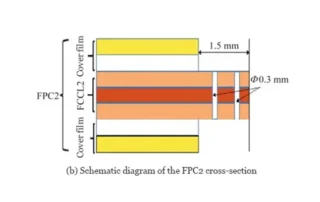
Back to Part 1 « Effect of Process Parameters on Line Widths in Circuit and Packaging Layers Process parameters are critical to the line widths in circuit and packaging layers. Therefore, this study investigated the effects of printing voltage, flow rate, and speed (see Figures 12 and 13). Fig. 12 Influence of process parameters on circuit width Fig.[...]
High-frequency FPC materials: LCP, MPI, and Low Dielectric Loss Trends (Part II)
High-frequency FPC materials are flexible circuit substrates built to keep signal loss low at GHz frequencies. They use resins with a low dielectric constant and a low dissipation factor, such as LCP, MPI, and fluororesins. This part of the guide explains how these materials differ and where each one fits. What Are High-frequency FPC materials? High-frequency FPC materials are[...]
Flex PCB: Basic Characteristics and types
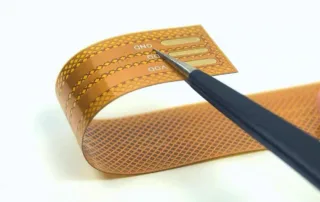
Flexible Printed Circuit Board (FPCB), commonly abbreviated as flexible board, also known as flexible circuit or soft board, is a bendable printed circuit board (PCB) and constitutes a major category within PCBs. Within the industry, some abbreviate FPCB as FPC. This is incomplete because “printed circuit” only represents part of the board and does not encompass the entire board.[...]
Flexible PCB Material Stack-Up: Types, Functions, and Performance
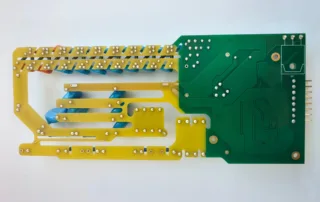
A printed circuit board (PCB) is defined as a functional board that provides point-to-point connection lines and printed component interconnections on an insulating substrate according to a predetermined design. A flexible printed circuit board (FPCB) is a functional board that forms printed circuits on a bendable, flexible insulating substrate. Its basic structure is shown in Figure 1. Figure[...]
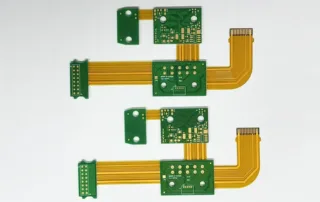
What are the core challenges in manufacturing Flex pcb?
As the “flexible nerves” of electronic devices, the manufacturing of FPC boards represents a precision art in modern industry. In smartphones, FPCs just 0.03mm thick must carry 10A currents; in satellite antennas, multilayer FPCs endure extreme temperature cycles from -180°C to 200°C. These seemingly contradictory performance metrics are precisely why FPC technology has long been pushed to the limits of[...]
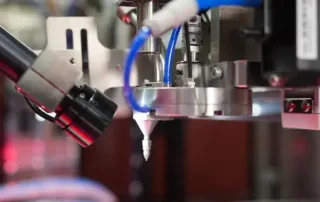
Precision Laser Soldering for FPCBs: Low Heat, High Reliability in Wearables and Medical Electronics
In fields such as consumer electronics, medical electronics, and wearable devices, flexible printed circuit boards (FPCBs) have become the core medium for achieving product miniaturization and structural innovation due to their characteristics of being lightweight, thin, bendable, and resistant to repeated bending. However, the substrate materials of Flex PCBs (such as PI film and PET film) exhibit poor heat resistance[...]
Advanced Manufacturing Technologies for High-Current, High-Shielding FPCB Solutions
Advanced Manufacturing Technologies for High-Current, High-Shielding FPCB Solutions A High-Shielding FPCB combines flexibility, thick copper traces, and shielding capability. Manufacturing such boards demands stepped copper from 245 μm to 105 μm, conductor thickness above 105 μm (3 oz), and integrated shielding layers that suppress radiation from parasitic inductance or stray capacitance. Why Demand for High-Shielding FPCB Is Rising With[...]
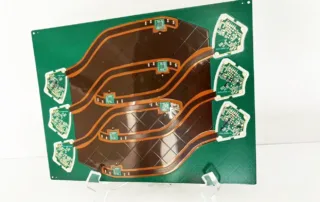
How to Achieve High Precision in Flexible Copper Clad Laminates Using Dual-Laser Etching?
Flexible copper-clad laminate (FCCL), serving as the substrate material for flexible printed circuits (FPC), offers distinct advantages such as lightweight, flexibility, compact size, and excellent heat resistance. Manufacturers widely adopt it in electronic products to achieve miniaturization and portability. This approach aligns with the development trends of high-precision electronics industries such as micro-robotics, new energy vehicles, 5G communication devices,[...]