
PET vs FPC Selection Guide: How to Choose the Right Circuit for Thin-Film Control Panels
PET vs FPC selection determines the conductor, cost, and bend life of a thin-film control panel circuit. PET uses printed silver ink on a polyester base. FPC uses etched copper foil on polyimide. This guide compares both options by trace width, tooling, volume, and reliability, so you can pick the right build.
What a Thin-Film Control Panel Circuit Must Deliver
A thin-film control panel circuit carries key signals, LED power, and sensor lines inside a flat stack. It sits under the graphic overlay and must survive lamination, pressing, and daily use. Therefore, the choice is not only about material cost.
Both options belong to the wider family of Flexible PCBs. However, they behave very differently once traces get dense, currents rise, or the tail must flex.
PET vs FPC Control Panel: Side-by-Side Comparison
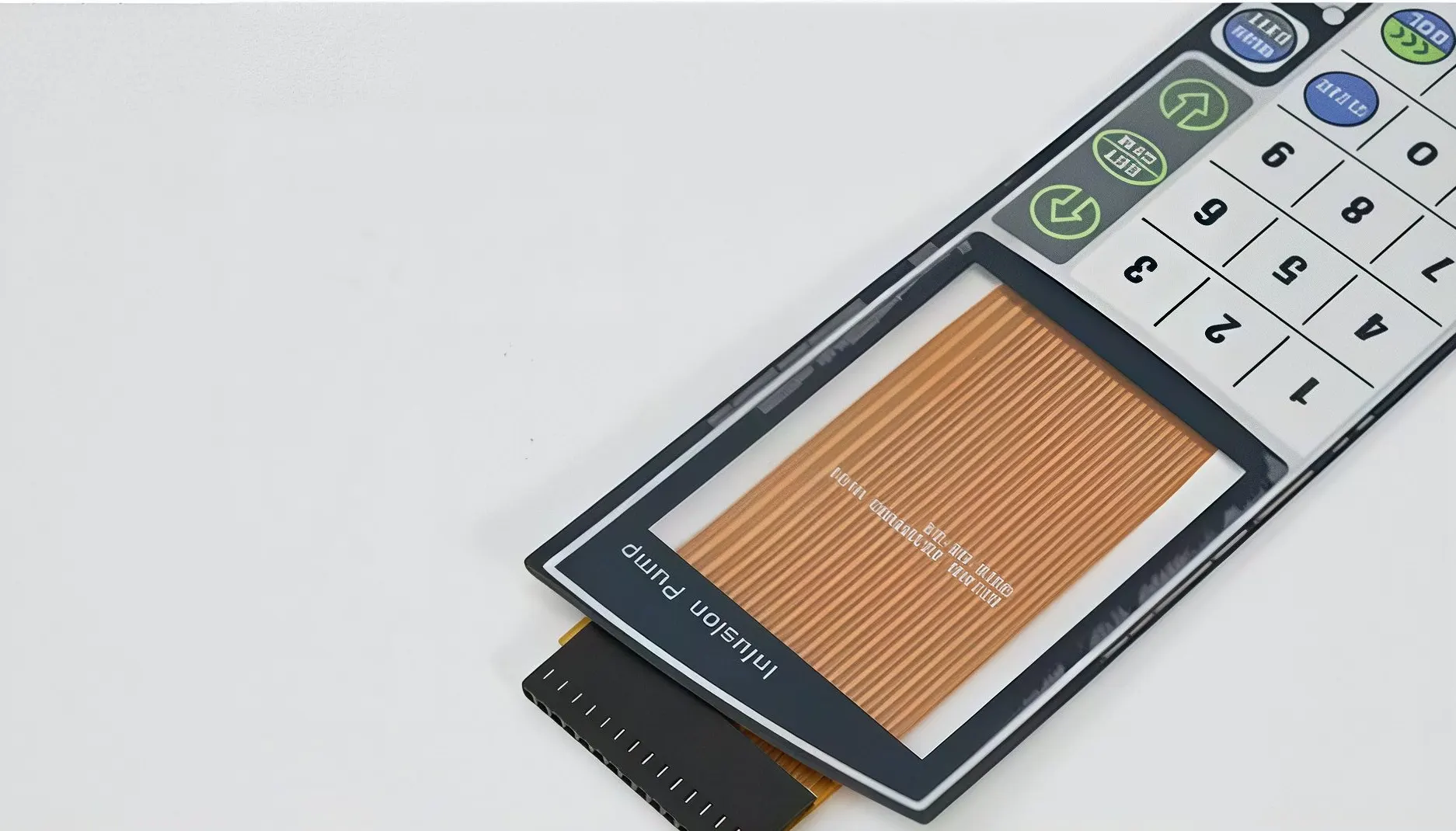
Thin-Film Control Panels using FPC
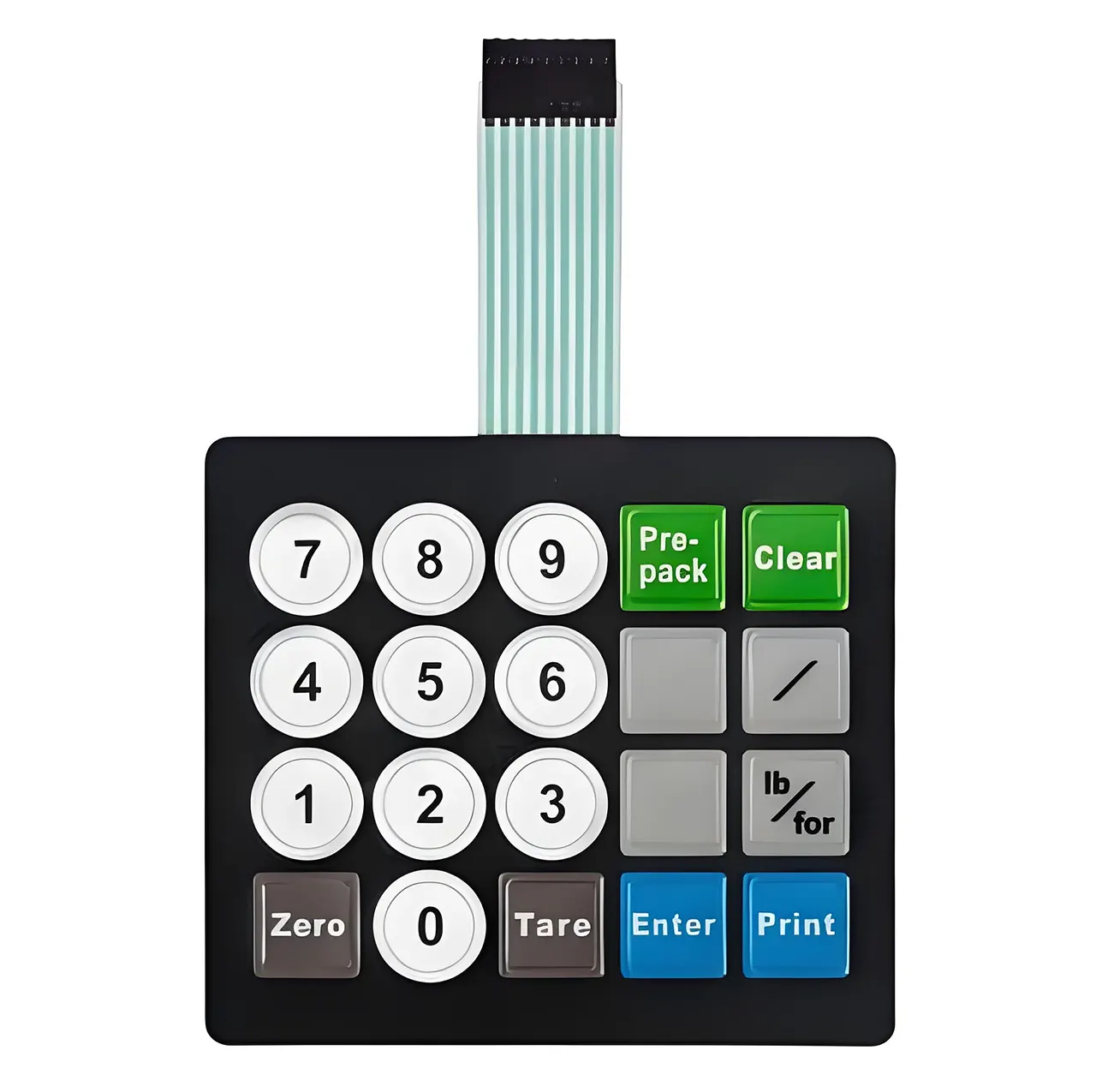
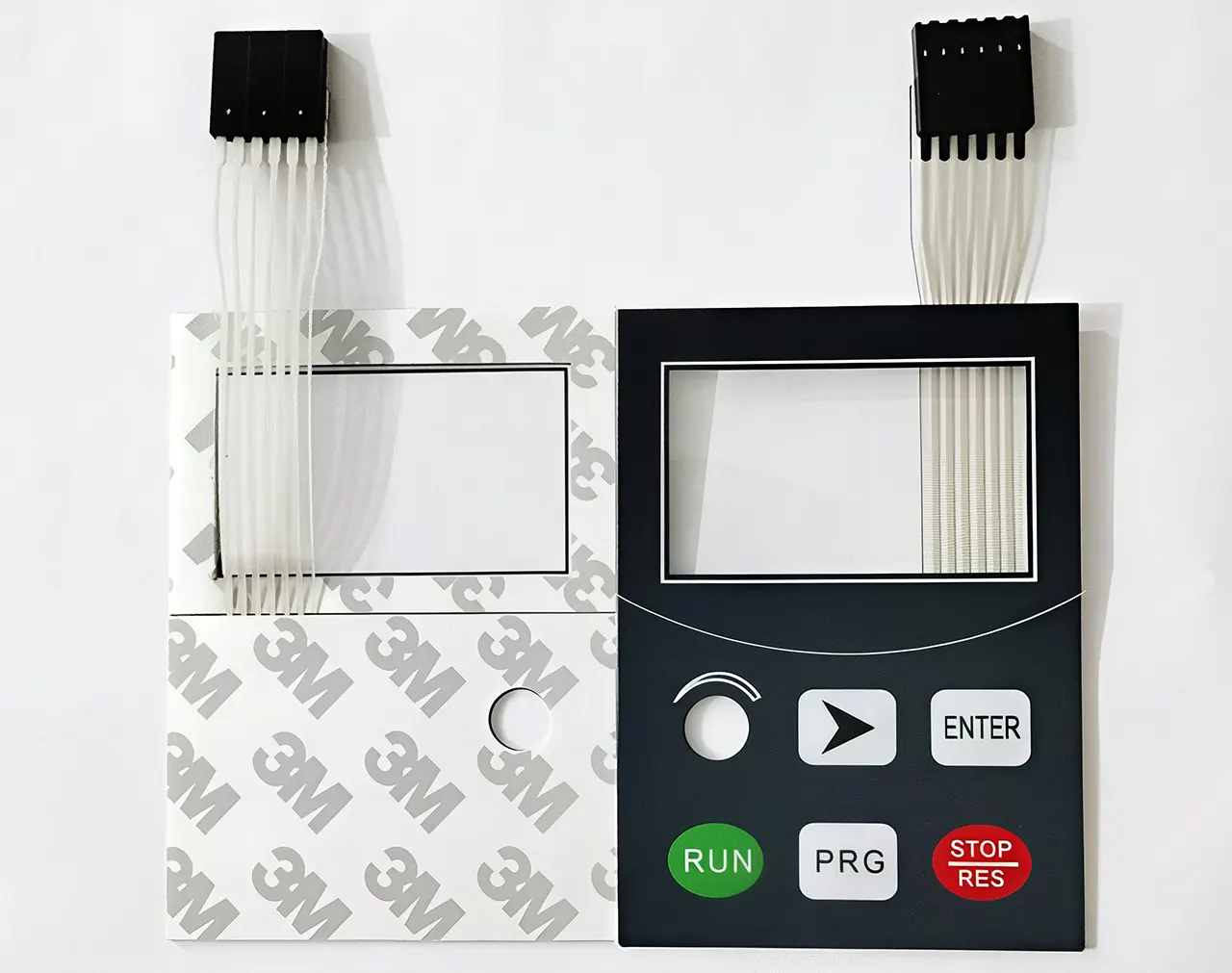
Thin-Film Control Panels using PET
The table below summarizes the practical differences for a PET vs FPC control panel project.
| Criterion | PET with silver ink | FPC with copper foil |
|---|---|---|
| Conductor | Printed silver ink | Etched copper foil |
| Base film | Polyester (PET) | Polyimide (PI) |
| Trace width and spacing | Wider traces required | Fine lines possible |
| Current carrying | Limited by ink resistance | Higher, copper conducts well |
| Bend life | Static, gentle folds only | Static and dynamic flexing |
| Tooling | Screens and dies | Artwork, etching, assembly |
| Best fit volume | Low to medium | Medium to high |
| Typical use | Membrane keypads, front panels | Display, sensor and hinge tails |
Silver ink is printed, so its resistance per square is much higher than copper. Copper foil is etched, so fine lines and tighter routing are possible. In addition, copper handles higher current on the same footprint.
Trace Width, Current Carrying and Design Margins
Silver ink needs wider traces and generous spacing. Designers should calculate voltage drop along the longest run and add margin for ink thickness variation. For example, a keypad matrix can stay narrow, while LED backlight lines usually need more width.
Copper FPCs allow finer lines, so dense display and sensor tails fit inside small hinges. The copper type matters too. Compare RA Copper vs ED Copper before you lock the stack, because bending areas favor rolled annealed foil.
Quantified Limits: Bend Life, Operating Temperature and Chemical Resistance
Use planning ranges to set the specification, then confirm them with coupons built in the actual process. The values below are typical boundaries, not guarantees for every stack.
| Property | PET with printed silver ink | FPC with copper on polyimide | Selection boundary |
|---|---|---|---|
| Static fold | One-time fold during assembly; avoid sharp creases | Repeated static folding possible | PET for flat or once-folded tails; FPC for hinge or moving tails |
| Dynamic flex | Normally not rated; 0–50 cycles at 1–2 mm radius can crack ink | 10,000–100,000+ cycles at 1–2 mm radius, design-dependent | If the drawing calls for more than 1,000 cycles, start with FPC |
| Operating temperature | About −20°C to +85°C typical; ink and adhesive limit the top end | About −40°C to +150°C typical; coverlay and finish limit the top end | Above +85°C, or near lead-free reflow, choose FPC |
| Chemical resistance | Fair to alcohols; poor to ketones, esters, and strong solvents | Good to most solvents; check coverlay, adhesive and strong bases | Solvent wash, fuel or cleaner exposure pushes FPC or sealed PET |
| Humidity and bias | Silver migration risk; seal trace edges and encapsulate | Lower migration risk, but polyimide moisture uptake still needs margin | 85°C/85% RH with bias favors FPC with coverlay |
If a PET design needs extra encapsulation, wider traces or multiple prints to meet these limits, its cost advantage can disappear. That is why the material choice should follow the environmental and flex requirements, not precede them.
Common Failure Modes to Design Out
Silver ink can migrate under bias and humidity, so seal the trace edges and avoid sharp die cuts. Copper traces fail by fatigue at bend points, so widen the bend radius and use curved routing. Both failures are preventable at the layout stage.
Environmental and Reliability Validation That Changes the Selection
Build a validation matrix before tooling. For flexible printed boards, IPC-6013 is the usual qualification framework; add bend test at the specified radius and cycle count, damp heat at 85°C/85% RH with bias, salt spray per ASTM B117 for the required hours, thermal shock, and insulation resistance. For silver-ink PET, add a migration check and a seal-integrity check after lamination.
The test plan can change the PET vs FPC decision. If the panel must meet IPC-6013 Class 2 or 3, an FPC with coverlay and a controlled finish is usually the lower-risk route. PET can still pass, but it needs sealed edges, encapsulated traces, and agreed test coupons. A PET build that adds these steps may lose the cost lead, while an FPC that fails a bend test at a tight radius may need a layout change rather than a material change.
Manufacturing Route and Tooling Cost
PET circuits are screen printed, then die-cut and laminated into the panel stack. Screens and dies are the main tooling, which keeps entry cost low. Also, the process suits simple single- or double-sided layouts.
FPCs are etched from copper-clad laminate, then covered, finished, and assembled. The FCCL vs. Rigid Copper Clad Laminate comparison explains why flexible laminates cost more up front. Our PCB Manufacturing FAQ covers the common process questions buyers ask.
Tail, Connector and Interface Options
PET tails usually end at a printed contact or a zebra strip that presses onto the PCB. FPC tails can carry a ZIF connector, a hot-bar bond pad, or a soldered joint. Therefore, FPC gives more freedom when the tail must plug in and out many times.
Volume Crossover and Total Cost of Ownership
Tooling dominates at low volume, so PET wins small and medium builds. FPC carries higher setup cost, but the unit price falls as panel quantity grows and yields stabilize. Next, add test, rework, and field-failure cost to the model.
Cost Crossover Model by Order Batch
Use a total-cost model rather than a unit-price comparison:
Total cost = tooling + (unit price × order quantity) + test and rework + field-failure allowance.
The breakeven quantity is (FPC tooling − PET tooling) ÷ (PET unit price − FPC unit price). If FPC unit price is not lower at volume, there is no crossover and PET remains the lower-cost route.
| Order batch | PET position | FPC position | Planning estimate |
|---|---|---|---|
| 100–1,000 pcs | Low screen and die tooling; fast sampling | Higher artwork, etch, and assembly setup | PET usually wins; choose FPC only for dynamic flex or fine pitch |
| 1,000–10,000 pcs | Unit cost stable; crossovers may add area | Setup amortized; assembly yield improves | Compare at real volume; dense panels may approach parity |
| Above 10,000 pcs | Material and print time dominate | Unit price falls with yield and panel utilization | For dense, high-current or flexing panels, FPC can break even around 10,000–15,000 pcs |
Illustrative dense-panel model: PET tooling $1,500 and unit $1.10; FPC tooling $6,000 and unit $0.75 at high volume. Breakeven = ($6,000 − $1,500) ÷ ($1.10 − $0.75) ≈ 12,900 pcs. Simple keypad model: PET tooling $1,000 and unit $0.45; FPC tooling $5,000 and unit $0.60. There is no crossover in normal volumes, so PET remains the cost choice. Replace these placeholders with supplier quotes and your own yield data.
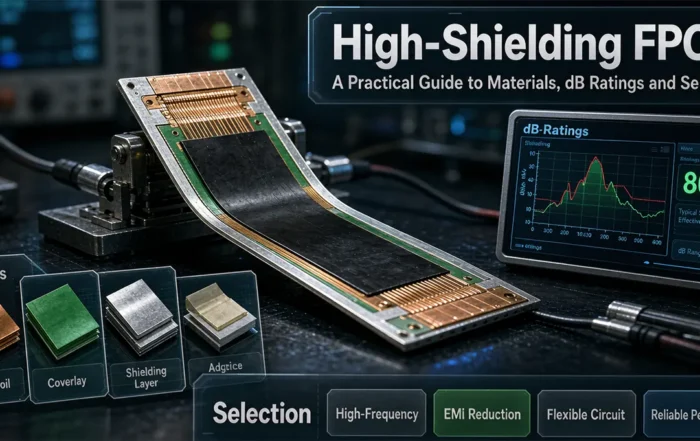
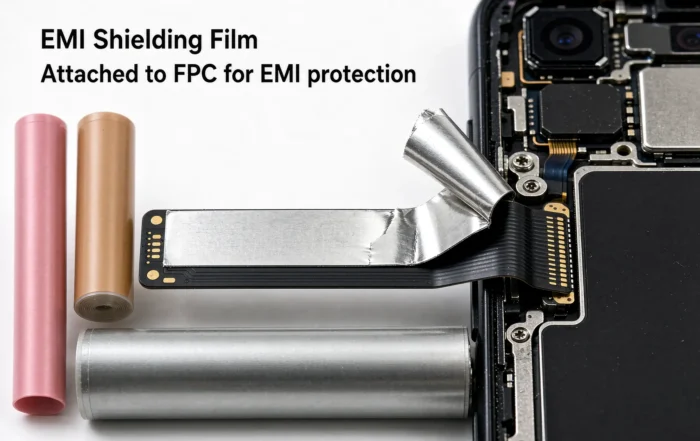
EMI is another cost line. Add an EMI shielding film when the tail runs near antennas or motors, and that option usually favors an FPC stack.
From Spec to Decision: How to Choose
Use this short flow to settle a PET vs FPC control panel decision.
1. Count keys, LEDs, and sensors, then estimate total current.
2. Check bend cycles, temperature, and chemical exposure against the quantified limits above.
3. Confirm the tail interface: press contact or plug-in connector.
4. Compare tooling plus unit cost at your real annual volume, using the crossover formula.
5. Review the reliability matrix, test and repair plans before release.
If the panel needs stiffeners or a mixed board-and-tail build, read Rigid-Flex PCB Technology before you finalize the stack. A Rigid-Flex PCB can remove a connector and improve assembly reliability. As a Flexible PCB Manufacturer since 2014, Gekun builds both membrane-style circuits and copper FPCs for consumer, medical, industrial, and automotive panels.
FAQ
Can a transparent window area use an FPC?
Yes. Copper traces are opaque, so route them outside the viewing window and keep the window clear. Designers can also print silver ink around the window on PET. In both cases, confirm the overlay adhesive and the light path before tooling.
Can a PET circuit be multilayer?
Usually no. PET silver-ink circuits are single- or double-sided and use printed crossovers for simple jumps. Multilayer builds with plated through holes belong to FPC or rigid-flex, where copper layers are laminated and drilled.
Which option is easier to repair in the field?
An FPC with a ZIF connector can be unplugged and replaced on its own. A PET circuit is normally bonded into the panel stack, so the whole panel is swapped. Therefore, the service strategy should join the PET vs FPC selection checklist early.
Does IPC-6013 apply to PET silver-ink circuits?
IPC-6013 is written for flexible printed boards, so it is the natural qualification reference for an FPC. A PET silver-ink circuit can be tested to the same bend, humidity, and insulation-resistance methods, but the supplier and buyer should agree which clauses apply. If the contract requires IPC-6013 qualification, confirm the PET process can produce the needed coupons and records before tooling.
Related Posts
- FCCL vs. Rigid Copper Clad Laminate: Key Differences — Related article
- Flexible PCBs Material Guide — Related article
- RA Copper vs ED Copper for Flexible PCB — Related article
- EMI Shielding Film for Flex Circuits: Selection Guide — Related article
- Choosing the Right Flex Circuit Connector | Gekun — Related article